What Is ShieldXDR and How Does It Work?
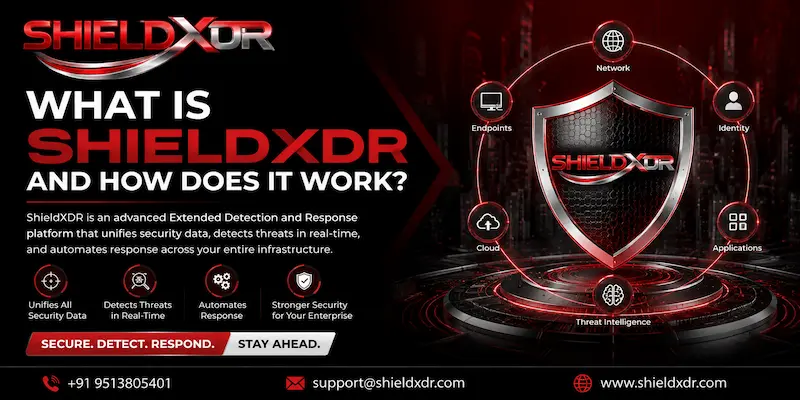
Do you know what ShieldXDR is, and how it can be helpful for organizations working in the IT Industry? If not, then you are at the right place. Here, we will talk about ShieldXDR in detail while explaining its main features.
Moreover, we will introduce you to a reputed VAPT Service Provider that can offer you the facility of ShieldXDR with ease. What are we waiting for? Let’s get started!
Modern Cybersecurity Challenges
The following are some of the modern cybersecurity challenges:
1. Explosive Rise of Generative AI Threats: GenAI is used by threat actors to create extremely realistic deepfakes and initiate automated phishing attempts.
2. Securing Decentralized Cloud & Remote Work: An organization's attack surface is significantly increased when business data is dispersed across home networks.
3. Sophisticated Ransomware-as-a-Service (RaaS): Pre-made malware toolkits can be purchased by inexperienced criminals, greatly increasing the number of extortion occurrences worldwide.
4. IoT and Critical Infrastructure Vulnerabilities: Power grids, healthcare systems, and factories are vulnerable to cyberattacks due to millions of unencrypted smart gadgets.
5. Shortage of Skilled Cybersecurity Professionals: Internal security staff are overworked and unable to protect against sophisticated threats due to a significant worldwide talent gap.
Why Businesses Need Advanced Cybersecurity Solutions?
Businesses need advanced cybersecurity solutions for the following reasons:
● Defending Against AI-Driven Threats: To identify and stop automated, quick cyberattacks that human teams are unable to stop on their own, sophisticated tools are necessary.
● Protecting Brand Reputation and Customer Trust: Strong security keeps your brand's integrity and customers' trust intact by preventing high-profile data breaches.
● Ensuring Regulatory and Legal Compliance: By keeping businesses in compliance with stringent international data regulations, modern technologies save them from harsh fines and legal action.
● Securing Hybrid and Remote Workforces: Cloud-focused security safeguards staff devices and decentralized corporate networks from any location in the world.
● Minimizing Downtime and Financial Loss: Catastrophic operational shutdowns and the enormous expenses related to data recovery are avoided via proactive threat protection.
The Difference Between Traditional Security and XDR
|
S.No. |
Topics |
Factors |
What? |
|
1. |
Traditional Security |
Isolated Data Pools |
Focuses on discrete, disjointed silos that need analysts to manually piece together an attack tale, such as collecting logs in isolation (SIEM) or defending endpoints alone (EDR). |
|
Reactive Alert Fatigue |
Largely relies on static rules and signatures, which produce a large number of unrelated warnings and allow serious threats to evade detection. |
||
|
Fragmented Incident Response |
Slows down containment efforts by requiring security teams to switch between several tools, management interfaces, and dashboards in order to look into a single danger. |
||
|
2. |
XDR |
Unified, Cross-Layer Visibility |
Automatically gathers and compiles telemetry data from emails, network servers, cloud workloads, and endpoints into a unified platform. |
|
AI-Driven Contextual Insights |
Reduces false positives significantly by using machine learning to combine small, seemingly unconnected abnormalities into a single, high-fidelity security incident. |
||
|
Automated, Orchestrated Mitigation |
Allows for the simultaneous blocking of a malicious IP address and the isolation of a compromised server throughout the entire company network, among other centralized, one-click, or fully automated reaction steps. |
What Is ShieldXDR?
Endpoint, network, email, and cloud security are all integrated into a single interface using Craw Security's sophisticated, unified Extended Detection and Response technology, ShieldXDR. It continuously correlates data from various sources to automatically neutralize sophisticated, zero-day cyber threats in real time by utilizing artificial intelligence, machine learning, and behavioral analytics.
How ShieldXDR Monitors Endpoints, Networks, and Cloud Systems?
In the following ways, ShieldXDR monitors endpoints, networks, and cloud systems:
a) Endpoints: In order to prevent malware and ransomware in real time, ShieldXDR uses AI-driven agent telemetry to track active processes, application activity, and system logs on workstations and servers.
b) Networks: In order to stop unwanted access, it tracks inbound and outgoing connection arcs using an interactive globe representation, analyzes real-time traffic flow, and applies dynamic firewall rule configurations.
c) Cloud Systems: It monitors user access, administrative modifications, and questionable configuration irregularities in SaaS apps like Office 365, AWS, and Azure, as well as multi-cloud infrastructure.
How ShieldXDR Detects Cyber Threats in Real Time?
|
S.No. |
Factors |
How? |
|
1. |
Multi-Layer Telemetry Aggregation |
Creates a single pipeline by combining real-time data streams from endpoints, networks, emails, and clouds. |
|
2. |
AI and Machine Learning Correlation |
Automatically creates a single, high-fidelity security event from small, dispersed system irregularities. |
|
3. |
Continuous Behavioral Pattern Matching |
Detects deviations from typical user and system actions to identify hidden zero-day threats. |
|
4. |
Live Global Threat Intelligence Feeds |
Instantly compares network behavior to the most recent global databases of malware signatures and known malicious IP addresses. |
|
5. |
Interactive Visualization Mapping |
Provides analysts with immediate geographic threat context by plotting active connection arcs onto a real-time global map. |
Key Features of ShieldXDR
The following are some key features of ShieldXDR:
1. AI-Powered Advanced Threat Detection: Prevents sophisticated malware and zero-day attacks via behavioral analysis and machine learning.
2. Unified XDR Dashboard & Visibility: Combines information from clouds, networks, endpoints, and emails into a single control panel.
3. Playbook-Driven Automated Incident Response: Carries out quick, automated tasks to limit risks, such as banning IPs or isolating hosts.
4. Global Threat Activity Mapping: Displays active network connection arcs providing geographic context on an interactive global map.
5. Built-in Data Loss Prevention (DLP) & Dark Web Monitoring: Actively searches the dark web for credentials that have been stolen while preventing sensitive data leaks.
Types of Cyber Threats ShieldXDR Can Help Prevent
The following are some types of cyber threats ShieldXDR can help prevent:
● Ransomware and Advanced Malware: Prevents the execution of harmful files and makes an effort to protect corporate systems through encryption.
● Zero-Day Exploits: Prevents new software assaults before vendors issue a remedy by using AI behavior tracking.
● Data Exfiltration and Leaks: Keep an eye on data flow to prevent rogue files or hackers from stealing company secrets.
● Insider Threats and Privilege Escalation: Detects unusual behavior or the acquisition of unwanted permissions by a compromised user account.
● Phishing and Email Attacks: Identifies bogus links, malware attachments, and social engineering traps by scanning email traffic.
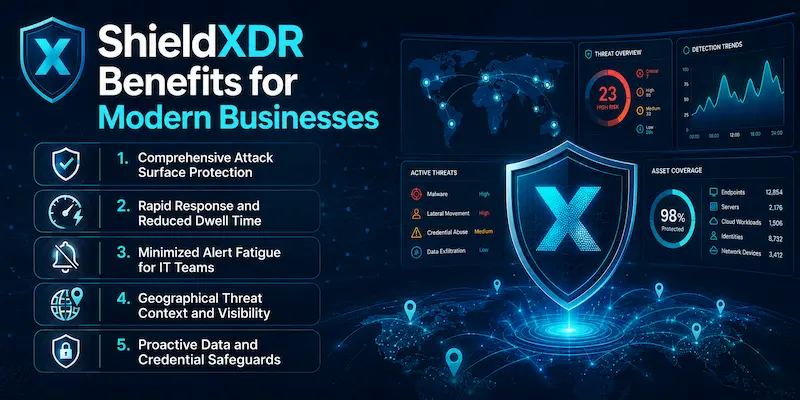
Benefits of Using ShieldXDR for Modern Businesses
|
S.No. |
Benefits |
How? |
|
1. |
Comprehensive Attack Surface Protection |
Unifies defense layers across endpoints, networks, emails, and cloud platforms to secure the whole company footprint. |
|
2. |
Rapid Response and Reduced Dwell Time |
Reduces the amount of time a hacker spends inside systems by quickly isolating threats using automated playbooks. |
|
3. |
Minimized Alert Fatigue for IT Teams |
Reduces notification overload for analysts by combining disparate network signals into a single, high-fidelity security issue. |
|
4. |
Geographical Threat Context and Visibility |
Plotting active connection arcs onto an interactive global map gives instant insight into the sources of traffic. |
|
5. |
Proactive Data and Credential Safeguards |
Protects the company's intellectual property by integrating active dark web monitoring for compromised credentials with data loss prevention. |
Industries That Can Benefit From ShieldXDR
Following are some industries that can benefit from ShieldXDR:
a) Banking and Financial Institutions (BFSI): Ensures tight regulatory compliance while protecting sensitive client financial data and high-value transactions.
b) Healthcare Organizations: Safeguards patient medical data across clinical networks and links hospital equipment and stops disruptive ransomware assaults.
c) E-commerce and Retail Logistics: Safeguards extremely dispersed supply chain networks, stops database scraping, and protects customer payment gateways.
d) Government Agencies and Defense: Protects governmental records, military networks, and vital national infrastructure against highly orchestrated, state-sponsored cyberespionage.
e) Hybrid Cloud and Tech Enterprises: Protects decentralized remote workforces, distributed DevOps pipelines, and multi-cloud systems from newly discovered zero-day vulnerabilities.
Zero Trust Architecture Integration
Enterprise defense is shifted from perimeter-based security to a rigorous "never trust, always verify" policy for each person, device, and network transaction through Zero Trust Architecture integration.
In order to reduce the lateral movement of threats within the network, security platforms use real-time telemetry, enforce micro-segmentation, and continuously authenticate access credentials.
The Future of AI-Powered Cybersecurity With XDR
An "agentic SOC," where autonomous AI agents go beyond simple detection to independently assess, prioritize, and contain multi-step threats in milliseconds, is the future of AI-powered cybersecurity with XDR.
By integrating automated cross-layer orchestration, quantum-ready cryptography, and predictive behavioral analytics, this development will totally reinvent corporate defense by thwarting extremely complex, AI-driven cyberattacks before they have a chance to cause harm.
Conclusion
Now that we have talked about ShieldXDR, you might want to get your hands on it as soon as possible. You can do that by getting in contact with Craw Security, a reputed VAPT service provider and the creator of this amazing tool.
This amazing tool can help you detect unknown cyber threats and respond to them in time to protect your data from higher risks. It can help organizations at the right time to be prepared for the unknown in advance. What are you waiting for? Contact, Now!
Frequently Asked Questions
About ShieldXDR
1. What Is ShieldXDR?
Craw Security created the exclusive, enterprise-grade Extended Detection and Response platform known as ShieldXDR.
2. How Does ShieldXDR Work?
In the following ways, ShieldXDR works:
a) Multi-Layer Data Collection,
b) Centralized Aggregation and Normalization,
c) AI-Driven Correlation and Analysis,
d) Interactive Visualization and Contextualization, and
e) Playbook-Driven Automated Containment.
3. What Does XDR Mean in Cybersecurity?
Extended Detection and Response, or XDR for short, is a comprehensive security platform that automatically gathers, correlates, and evaluates telemetry data from endpoints, networks, cloud environments, and emails in order to instantly neutralize complex cyber threats.
4. How Is ShieldXDR Different From Traditional Antivirus Software?
ShieldXDR employs cross-layer AI behavioral analytics to automatically identify and eliminate complex, multi-vector threats throughout your entire network, cloud, and endpoints in real time, in contrast to traditional antivirus software that uses static signatures to block known malware on individual devices
.
5. What Types of Cyber Threats Can ShieldXDR Detect?
ShieldXDR can detect the following types of cyber threats:
a) Ransomware and Advanced Malware,
b) Zero-Day Exploits,
c) Data Exfiltration and Leaks,
d) Insider Threats and Privilege Escalation, and
e) Phishing and Email Attacks.
6. How Does AI Help ShieldXDR Improve Threat Detection?
In the following ways, ShieldXDR improves threat detection:
a) Behavioral Baseline Mapping,
b) Cross-Layer Alert Correlation,
c) Zero-Day Exploit Detection,
d) Elimination of Alert Fatigue, and
e) Predictive Attack Path Analysis.
7. Can ShieldXDR Protect Cloud and On-Premise Environments?
Yes, ShieldXDR unifies data gathering and automatic threat response throughout your whole hybrid environment into a single management panel, seamlessly protecting both on-premises infrastructure and cloud platforms.
8. Why Do Businesses Need an XDR Solution?
Businesses need an XDR solution for the following reasons:
a) Defense Against Multi-Stage Attacks,
b) Dramatically Lowered Detection and Response Times,
c) Complete Visibility Across Hybrid Workforces,
d) Relief from Severe Alert Fatigue, and
e) Proactive Protection for Data and Compliance.
9. What Are the Main Features of ShieldXDR?
The following are the main features of ShieldXDR:
a) AI-Powered Advanced Threat Detection,
b) Unified XDR Dashboard & Visibility,
c) Playbook-Driven Automated Incident Response,
d) Global Threat Activity Mapping, and
e) Built-in Data Loss Prevention (DLP) & Dark Web Monitoring.
10. How Does ShieldXDR Help Organizations Respond to Cyberattacks Faster?
In the following ways, ShieldXDR helps organizations respond to cyberattacks faster:
a) Automated Playbook Execution,
b) Unified Control Panel Actionability,
c) Elimination of Manual Alert Triage,
d) Visual Attack Path Reconstruction, and
e) Continuous Global Threat Enrichment.
Daksh
Cybersecurity expert and contributor at ShieldXDR, dedicated to sharing insights on threat detection, response, and overall digital security posture.