How Does XDR Protect Endpoints, Networks, and Cloud Workloads?

Do you know what XDR is, its uses, and benefits for organizations working in the IT Industry with an online business? If not, then you are in the right place. Here, we will talk about XDR and related features in detail.
Moreover, we will introduce you to a reliable security solution offered by a reputable VAPT service provider. What are we waiting for? Let’s get straight to the topic!
What Is XDR?
A comprehensive cybersecurity platform called Extended Detection and Response (XDR) automatically gathers and correlates information from servers, networks, endpoints, and cloud environments.
It replaces fragmented monitoring to offer clear visibility into intricate, multi-vector cyber threats by combining these diverse security silos into a single pane of glass. Security teams may prioritize actual threats more quickly and carry out automatic threat containment and remediation throughout the whole digital infrastructure thanks to this all-encompassing methodology.
Let’s explore what XDR is, its features, its uses, and its benefits for businesses operating in the IT Industry!
Why Do Organizations Need XDR for Modern Cybersecurity?
Organizations need XDR for modern cybersecurity for the following reasons:
1. Breaks down security silos: Combines disparate telemetry from networks, cloud environments, and endpoints into a single, coherent perspective.
2. Eliminates alert fatigue: Correlates hundreds of raw signals into high-fidelity, prioritized incidents, allowing analysts to concentrate exclusively on actual risks.
3. Accelerates response times: Automates cross-domain cleanup and detection to stop sophisticated threats before they do serious harm.
4. Protects hybrid and multi-cloud footprints: Provides uniform, end-to-end security visibility across dispersed multi-cloud assets and intricate on-premises architecture.
5. Mitigates the cybersecurity skills gap: Smaller or less skilled security teams can successfully protect against sophisticated threats thanks to streamlined workflows and guided automation.
XDR vs. EDR, MDR, and SIEM
|
S.No. |
Topics |
Factors |
What? |
|
1. |
XDR |
Cross-Domain Integration |
Telemetry from endpoints, network infrastructure, email, identity, and cloud workloads is automatically gathered, correlated, and analyzed. |
|
Built-in Automation |
Automatically isolates threats across several levels without the need for human interaction by combining direct response capabilities with native threat detection. |
||
|
2. |
EDR |
Single-Domain Focus |
Keeps an eye on and protects specific endpoints, such as servers, laptops, and desktop computers. |
|
Narrow Visibility |
Lacks visibility into network traffic, identity, and cloud settings, but offers extremely detailed information about host-level risks. |
||
|
3. |
MDR |
Service-Driven Model |
Threat hunting, monitoring, and response are handled by third-party security specialists on your behalf in this human-managed service. |
|
Tool Agnostic |
Experts frequently utilize EDR or XDR technologies in the background; MDR is an operational delivery consequence rather than a stand-alone technology. |
||
|
4. |
SIEM |
Log Collection & Compliance |
Combines enormous amounts of log data from the whole company for compliance reporting, auditing, and long-term retention. |
|
Manual Management |
Lacks native, automatic cross-domain repair and requires a large number of custom correlation rules and specialized engineers to prioritize alarms. |
Key Features and Capabilities of XDR
The following are some key features and capabilities of XDR:
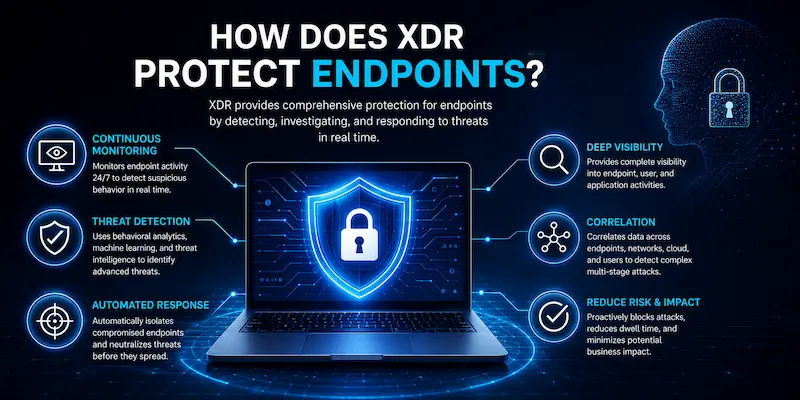
● Cross-Domain Data Aggregation: Integrates and standardizes telemetry into a single repository from endpoints, network traffic, identity systems, and cloud environments.
● Automated Threat Correlation: Integrates disparate inputs from several vectors into a single, coherent incident context using AI and behavioral analytics.
● Centralized Visibility & Triage: Reduces warning noise and prioritizes high-risk threats by combining many security KPIs into a single dashboard.
● Automated Incident Response: Uses pre-written orchestration playbooks to quickly block rogue IPs across the network, isolate endpoints, or revoke user access.
● Threat Intelligence Integration: Continuously adds real-time global threat feeds to telemetry to proactively detect new attack methods and signs of compromise.
Endpoint Threat Detection and Behavioral Analysis
In order to record process executions, registry changes, and file alterations in real time, endpoint threat detection continuously monitors host-level activities. XDR detects suspicious anomalies and zero-day exploits that evade conventional signature-based antiviruses by applying behavioral analysis and machine learning to this information, enabling prompt automatic containment.
Network Monitoring and Threat Detection With XDR
In order to detect covert lateral movement and illicit data exfiltration, XDR network monitoring records real-time traffic flow, protocol metadata, and packet payloads throughout enterprise networks.
XDR detects malicious behavior, such as command-and-control communication, before it causes a system-wide breach by comparing network anomaly patterns with endpoint and cloud telemetry.
Cloud Threat Detection and Security Monitoring
In order to identify setup errors, unauthorized access, and unusual workload behavior, cloud threat detection continuously examines API logs, serverless functions, and container environments.
XDR guarantees end-to-end security across dynamic multi-cloud architectures without generating monitoring blind spots by connecting cloud telemetry with endpoint and network activities.
How Does XDR Connect Endpoint, Network, and Cloud Security?
XDR connects endpoint, network, and cloud security in the following ways:
a) Unified Telemetry Ingestion: Integrates signals and logs from cloud workloads, network sensors, and endpoints into a single pool.
b) Cross-Domain Signal Correlation: Reveals the full attack story by connecting linked anomalies across many tiers.
c) Normalized Threat Mapping: Allows for consistent analysis by standardizing different vendor data into MITER ATT&CK frameworks.
d) Centralized Contextual Dashboard: Eliminates platform hopping by displaying all cross-vector activities in a single screen.
e) Synchronized Orchestrated Response: Initiates concurrent containment measures for cloud, network, and endpoint assets.
Threat Intelligence and Data Correlation in XDR
By comparing incoming network, endpoint, and cloud signals to global threat databases and known indicators of breach, threat intelligence enhances raw security telemetry. Security teams can swiftly comprehend threat context and remove false positives thanks to XDR's ability to combine disparate events into a cohesive attack narrative by using correlation engine algorithms on this enriched data.
Automated Incident Response and Remediation
As soon as malicious correlation is found across systems, automated incident response quickly runs pre-configured playbooks to contain cyberattacks. XDR reduces dwell time and stops lateral propagation before analysts step in by automatically isolating attacked hosts, removing compromised user credentials, and banning malicious IPs.
Best Practices for Implementing XDR
The following are the best practices for implementing XDR:
1. Audit and optimize existing tools: Before connecting to XDR, inventory active security tools to close telemetry gaps and remove duplicated feeds.
2. Prioritize high-value data sources: For optimal initial coverage, connect essential endpoints, core identification systems, and important network choke points first.
3. Map workflows to MITRE ATT&CK: To guarantee complete coverage of attacker strategies and tactics, standardize detection methods against common frameworks.
4. Start with semi-automated playbooks: Before moving to complete automation, require analyst clearance for reaction activities to avoid unintentional disruptions.
5. Continuously tune and validate: To minimize false positives and stay up to date with changing threats, conduct breach simulations on a regular basis and modify correlation rules.
Common Challenges When Deploying XDR
|
S.No. |
Challenges |
What? |
|
1. |
Integration complexity with legacy tools |
Telemetry gaps and sync problems are frequently caused when legacy infrastructure and heterogeneous, multi-vendor security technologies are connected via APIs. |
|
2. |
High initial configuration overhead |
To avoid false positives, it takes a lot of work to customize correlation rules, adjust behavioral models, and set baseline activity. |
|
3. |
Risk of over-automated playbooks |
Response scripts that are incorrectly set may unintentionally isolate important servers, deny executive access, or disrupt business operations. |
|
4. |
Data ingestion and bandwidth costs |
High data pipeline expenses result from streaming, standardizing, and storing enormous amounts of cross-domain logs across endpoints, networks, and clouds. |
|
5. |
Shortage of skilled SOC personnel |
Expert analysts are still needed to optimize modern XDR capabilities and investigate intricate cross-vector threats, which exacerbates the lack of cybersecurity talent. |
Conclusion: Strengthening Security With XDR
Now that we have talked about what XDR is, you might want to get a dedicated XDR solution for better protection against cyber threats globally. For that, you can go for ShieldXDR, a dedicated threat detection and response tool offered by Craw Security.
ShieldXDR can help businesses by automatically detecting unknown cyber threats and responding to them without any human intervention. Thus, you can rely on it for safety purposes. What are you waiting for? Contact, Now!
Frequently Asked Questions
About XDR
1. What is XDR and how does it protect an organization?
A comprehensive cybersecurity platform called Extended Detection and Response (XDR) continuously gathers, correlates, and analyzes data from endpoints, networks, identities, and cloud workloads to automatically identify and contain multi-vector threats within a company.
2. How does XDR protect endpoint devices?
XDR protects endpoint devices in the following ways:
a) Behavioral anomaly detection,
b) Continuous telemetry monitoring,
c) Automated host isolation,
d) Automated process killing & rollback, and
e) Vulnerability & exposure management.
3. How does XDR detect threats across networks?
XDR detects threats across networks in the following ways:
a) Deep packet inspection & payload parsing,
b) Network Traffic Analysis (NTA) & behavioral baselining,
c) Lateral movement detection,
d) Command-and-Control (C2) callback tracking, and
e) Cross-layer signal correlation.
4. How does XDR secure cloud workloads?
XDR secures cloud workloads in the following ways:
a) API & control plane telemetry ingestion,
b) Workload & container runtime monitoring,
c) Cross-cloud signal correlation,
d) Identity & entitlement behavioral analytics, and
e) Automated cloud asset containment.
5. Can XDR detect threats in real time?
In order to provide immediate alarms and containment measures, XDR continuously streams telemetry from endpoints, networks, and cloud workloads into automated AI correlation engines.
6. How does XDR correlate security data from different sources?
XDR correlates security data from different sources in the following ways:
a) Data ingestion & normalization,
b) Entity & identity mapping,
c) Temporal & sequence alignment,
d) Behavioral analytics & ML baseline, and
e) Threat intelligence enrichment.
7. What types of cyber threats can XDR detect?
XDR can detect the following types of cyber threats:
a) Advanced Persistent Threats (APTs),
b) Ransomware & Zero-Day Exploits,
c) Identity Compromise & Insider Threats,
d) Cloud Infrastructure Misconfigurations & Exploits, and
e) Phishing & Business Email Compromise (BEC).
8. What is the difference between XDR and EDR?
By combining and correlating information from endpoints, networks, cloud workloads, and identity systems into a single platform, XDR broadens the scope of EDR's monitoring and response to threats on individual endpoint devices.
9. How does XDR improve incident response?
XDR improves incident response in the following ways:
a) Unified Incident Visibility,
b) Automated Containment & Remediation,
c) Reduced False Positives,
d) Accelerated Triage & Investigation, and
e) Dramatically Lowered MTTD & MTTR.
10. Why should organizations use XDR for endpoint, network, and cloud security?
Organizations should use XDR for endpoint, network, and cloud security for the following reasons:
a) Complete End-to-End Visibility,
b) Faster Detection and Response (MTTD/MTTR),
c) Correlated Threat Context,
d) Streamlined Security Operations, and
e) Neutralization of Multi-Vector Attacks.
Daksh
Cybersecurity expert and contributor at ShieldXDR, dedicated to sharing insights on threat detection, response, and overall digital security posture.