How to Detect Insider Threats with XDR and User Behavior Analytics?

Do you know what are the ways to Detect Insider Threats with XDR and user behavior analytics that can protect you against online threats? If not, then you are in the right place. Here, we will talk about detecting insider threats and related benefits in detail.
Moreover, we will introduce you to a reliable XDR solution offered by a reputable VAPT service provider. What are we waiting for? Let’s get straight to the topic!
What Are Insider Threats?
When current or former workers, contractors, or business colleagues abuse their authorized access to digital assets or networks, it is known as an insider threat. These risks might arise unintentionally through staff carelessness, policy infractions, and stolen credentials, or purposefully through malevolent data theft and sabotage.
These people's acts circumvent conventional perimeter protections and are frequently much more difficult to identify since they already have authorized system access. Let’s take a look at how to Detect Insider Threats with XDR and user behavior analytics to protect yourself against unknown threats!
Types of Insider Threats (Malicious, Careless, Compromised)
The following are some types of insider threats:
1. Malicious: An authorized insider who purposefully compromises systems, steals data, or discloses private information for retaliation or personal benefit.
2. Careless: An employee who unintentionally creates a security breach by being careless, using weak passwords, or falling for phishing scams.
3. Compromised: An external attacker has taken control of an innocent user's device or genuine credentials to penetrate the network.
Why Do Traditional Security Tools Struggle to Detect Insider Threats?
Traditional security tools struggle to detect insider threats for the following reasons:
● Legitimate Access Bypasses Perimeter Defenses: Because firewalls and perimeter tools rely on verified credentials, insiders are allowed to roam around without setting off alarms.
● Inability to Distinguish Between Normal and Malicious Activity: Unauthorized access is flagged by traditional restrictions rather than authorized users misusing their allowed permissions.
● Blind Spots Across Fragmented Technical Silos: Isolated user actions across networks, clouds, and endpoints cannot be correlated by disconnected security technologies.
● High Volume of False Positives Causes Alert Fatigue: Analysts are overloaded with noise from static alert rules, which makes it difficult to spot small insider irregularities.
● Ineffectiveness Against Non-Malicious or Compromised Insiders: Signature-based technologies are unable to identify negligent employee errors or credentials that have been compromised and are acting normally.
What Is Extended Detection and Response (XDR)?
A security technology called Extended Detection and Response (XDR) automatically combines and correlates threat data from servers, networks, endpoints, cloud workloads, and email environments.
It enables automated, real-time threat detection and incident response throughout the whole IT company by dismantling security silos.
What Is User Behavior Analytics (UBA)?
In order to create behavioral baselines for each user, User Behavior Analytics (UBA) is a cybersecurity procedure that monitors, gathers, and examines typical human activity data across networks.
In order to identify potential insider threats and compromised credentials in real time, it uses machine learning to continuously watch for aberrant patterns like unusual login times or abrupt file downloads.
How Do XDR and UBA Work Together to Detect Insider Threats?
XDR and UBA work together to detect insider threats in the following ways:
a) UBA Establishes Context While XDR Feeds Cross-Silo Visibility: While UBA creates baseline behavioral profiles to identify anomalies, XDR broadcasts information across all vectors.
b) Multi-Signal Alert Correlation Prevents False Alarms: Background noise is eliminated by combining behavioral changes with endpoint and network events.
c) Rapid Risk Scoring Accelerates Incident Prioritization: In order to identify high-threat insiders for immediate inquiry, user risk scores automatically update.
d) Early Detection of Credential Abuse and Lateral Movement: As soon as an insider switches across systems, behavioral changes expose credentials that have been stolen.
e) Automated Playbooks Instantly Contain Threat Impacts: When UBA reaches a critical risk threshold, XDR automatically isolates endpoints or revokes access.
Role of AI and Machine Learning in Insider Threat Detection
|
S.No. |
Roles |
What? |
|
1. |
Baseline Behavioral Profiling |
ML algorithms map typical operating patterns for each account by continuously analyzing everyday user activity. |
|
2. |
Real-Time Anomaly Detection |
AI instantly detects minute irregularities, such as odd working hours or large data transfers, by scanning live telemetry. |
|
3. |
Dynamic Threat and Risk Scoring |
Individual user risk scores are regularly recalculated by algorithms depending on the frequency and intensity of questionable activity. |
|
4. |
Alert Noise and False Positive Reduction |
In order to highlight truly high-risk insider events and filter out benign errors, machine learning correlates low-level signals. |
|
5. |
Automated Threat Containment |
When crucial risk thresholds are exceeded, AI immediately initiates defensive measures like device isolation or access revocation. |
Key User Behavior Signals That Indicate an Insider Threat
The following are some key user behavior signals that indicate an insider threat:
1. Anomalous Data Exfiltration: Downloading, copying, or sending abnormally large amounts of private files to personal devices or unapproved cloud storage.
2. Abnormal Authentication Patterns: Logging in during non-working hours, from unexpected places, or during several concurrent sessions.
3. Privilege Escalation & Unauthorized Access: Attempting to access databases, administrative tools, or private folders outside of their designated work function.
4. Security Controls Circumvention: Employing unapproved VPNs, installing unapproved shadow IT applications, disabling endpoint security agents, or changing system logs.
5. Flight-Risk Activity Spikes: Abrupt increases in the number of people using job-search websites, printing large files, or downloading large amounts of data soon after quitting or getting a bad performance report.
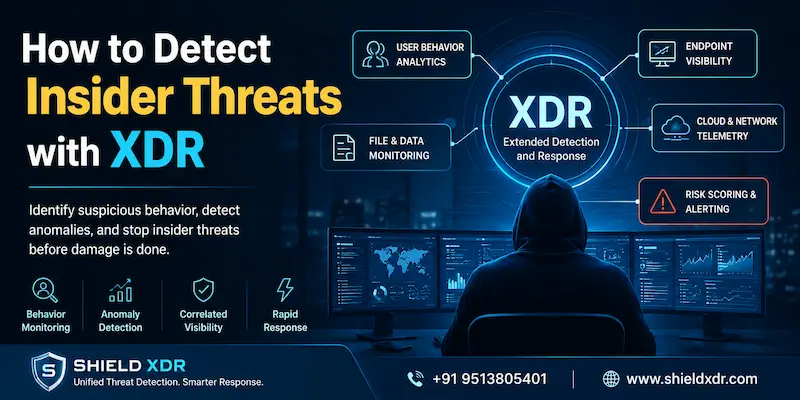
Common Insider Threat Scenarios Detected by XDR and UBA
The following are some common insider threat scenarios detected by XDR and UBA:
● Intellectual Property Theft by Departing Employees: Before departing, departing employees download customer lists or proprietary code to their personal drives.
● Account Hijacking & Lateral Movement via Stolen Credentials: External attackers can traverse between network segments covertly by utilizing employee logins that have been compromised.
● Disgruntled Privilege Abuse & Sabotage: Elevated permissions are being used by disgruntled administrators to change setups, remove important databases, or launch logic bombs.
● Negligent Policy Violations & Shadow IT: Sensitive files are sent by employees via personal email or unapproved cloud apps, circumventing security measures.
● Rogue Third-Party & Contractor Exploitation: Vendor accounts are misusing temporary access window extensions to gain unauthorized access to sensitive systems or steal data.
Benefits of Combining XDR with User Behavior Analytics
|
S.No. |
Benefits |
How? |
|
1. |
Holistic Cross-Silo Visibility |
Combines behavioral insights with security telemetry from endpoints, networks, the cloud, and email to eliminate technical blind spots. |
|
2. |
Dramatically Lower False Positives |
Suppresses benign signals and draws attention to real insider threats by correlating behavioral abnormalities with technological indications. |
|
3. |
Accelerated Threat Detection & MTTD |
By automatically identifying tiny insider behaviors before damage spreads, it lowers Mean Time to Detect (MTTD). |
|
4. |
Automated & Precise Response |
Allows for immediate targeted confinement without interfering with regular processes, such as removing user credentials or isolating a device. |
|
5. |
Enhanced Forensic Context |
Simplifies post-incident investigations and compliance reporting by offering a single timeline of user activity across all vectors. |
Best Practices for Detecting and Responding to Insider Threats
The following are the best practices for detecting and responding to insider threats:
a) Implement Zero Trust and the Principle of Least Privilege: Strictly limit access according to job roles and demand ongoing user authentication.
b) Establish Behavioral Baselines with XDR and UBA: Integrate analytics and cross-silo telemetry to automatically identify deviations from typical user behavior.
c) Define Automated Incident Response Playbooks: When critical threat thresholds are reached, set up quick containment steps to isolate endpoints or revoke access.
d) Build a Cross-Functional Insider Threat Team: To accurately evaluate and manage insider risks with complete operational context, unify Security, HR, Legal, and Management.
e) Conduct Continuous Security Awareness & Offboarding Audits: Provide regular security hygiene training to employees and make sure that departing employees' access is immediately revoked.
Conclusion
Now that you know how to Detect Insider Threats with XDR and user behavior analytics, you might want to get your hands on a dedicated security solution. For that, you can go for ShieldXDR, a dedicated threat detection and response tool offered by Craw Security.
ShieldXDR can help organizations by automatically detecting any unknown cyber threats and dealing with them without any human intervention. Thus, you will feel secure while working online. What are you waiting for? Contact, Now!
Frequently Asked Questions
About Detecting Insider Threats with XDR
1. What Is an Insider Threat in Cybersecurity?
When a current or former employee, contractor, or business partner abuses permitted access to jeopardize an organization's data or systems, it's known as an insider threat.
2. How Does XDR Help Detect Insider Threats?
XDR helps detect insider threats in the following ways:
a) Integrates Cross-Silo Telemetry,
b) Tracks Lateral Movement,
c) Detects Anomalous File Activity,
d) Correlates Identity with System Signals, and
e) Triggers Automated Containment.
3. What Is User Behavior Analytics (UBA)?
A cybersecurity procedure called User Behavior Analytics (UBA) employs machine learning to create baselines for typical user behavior and quickly identify unusual activity that might point to compromised accounts or insider threats.
4. How Does UBA Identify Suspicious User Behavior?
UBA identifies suspicious user behavior in the following ways:
a) Establishes Baseline Activity Profiles,
b) Detects Anomalous Data Access,
c) Monitors Authentication Anomalies,
d) Tracks Privilege Escalation Attempts, and
e) Calculates Dynamic User Risk Scores.
5. How Do XDR and UBA Work Together to Detect Insider Threats?
XDR and UBA work together to detect insider threats in the following ways:
a) Combines Behavioral Context with Deep System Telemetry,
b) Correlates Multi-Vector Signals to Suppress False Alarms,
c) Dynamically Adjusts Risk Scores Across the Enterprise,
d) Exposes Stolen Credentials and Lateral Movement, and
e) Enables Automated and Targeted Containment.
6. What User Activities Can Indicate an Insider Threat?
The following user activities can indicate an insider threat:
a) Unusual Bulk Data Downloads,
b) Access Outside Role Scope,
c) Abnormal Working Hours and Login Locations,
d) Bypassing Security Controls, and
e) Sudden Resignation or Flight-Risk Indicators.
7. Can XDR Detect Malicious and Accidental Insider Threats?
Yes, XDR continuously monitors cross-silo data to identify patterns of intentional exfiltration attempts as well as inadvertent policy violations, misconfigurations, or compromised credentials. This allows it to identify both malicious and unintentional insider threats.
8. How Does AI Improve Insider Threat Detection?
AI improves insider threat detection in the following ways:
a) Detects Subtle Behavioral Anomaly Sequences,
b) Processes Heterogeneous Telemetry at Scale,
c) Calculates Dynamic Real-Time Risk Scores,
d) Dramatically Reduces Alert Fatigue, and
e) Triggers Automated Containment at Machine Speed.
9. What Are the Benefits of Combining XDR with UBA?
The following are the benefits of combining XDR with UBA:
a) Unified Cross-Silo Visibility,
b) Significant Reduction in False Positives,
c) Accelerated Threat Detection and MTTD,
d) Targeted and Automated Response, and
e) Enriched Investigation and Forensics.
10. How Can Organizations Reduce the Risk of Insider Threats?
Organizations can reduce the risk of insider threats in the following ways:
a) Enforce Zero Trust and Least Privilege Architecture,
b) Deploy Integrated Behavioral Monitoring (UBA & XDR),
c) Implement Strict Offboarding and Access Lifecycle Management,
d) Classify and Encrypt Sensitive Enterprise Data, and
e) Foster Continuous Security Awareness and Culture.
Daksh
Cybersecurity expert and contributor at ShieldXDR, dedicated to sharing insights on threat detection, response, and overall digital security posture.