How to Detect Lateral Movement Before a Breach Spreads?
Do you know what Lateral Movement is and how you can protect yourself against it with better security measures? If not, then you are in the right place. Here, we will talk about what lateral movement is and related prevention techniques in detail.
Moreover, we will introduce you to a reliable security solution offered by a reputable VAPT service provider. What are we waiting for? Let’s get straight to the topic!
What Is Lateral Movement in Cybersecurity?
In cybersecurity, the term "lateral movement" describes the methods that attackers employ to gradually migrate through a network once they have established an initial foothold. Adversaries penetrate further into systems to find valuable assets by stealing more credentials, taking advantage of internal weaknesses, and increasing privileges.
Cybercriminals can sustain persistence, broaden their reach, and get ready for significant data exfiltration or system damage during this critical stage. Let’s take a look at what Lateral Movement and what the best security solutions are for that!
Why Is Lateral Movement a Critical Stage of a Cyberattack?
Lateral movement is a critical stage of a cyberattack for the following reasons:
1. Enables Access to High-Value Assets: Enables hackers to access sensitive databases, domain controllers, and vital operational systems by going beyond first points of entry.
2. Establishes Deep Network Persistence: Allows adversaries to stay connected even after their initial entry vector is patched by securing several footholds across various platforms.
3. Facilitates Privilege Escalation: Gives the attacker the chance to obtain higher-level admin credentials while moving between linked machines.
4. Maximizes Attack Blast Radius: Increases control throughout the company to carry out bulk data exfiltration, increase damage, or make room for the spread of ransomware.
5. Explores Vulnerable Internal Boundaries: Takes advantage of unmonitored East-West traffic paths, flat network portions, and weaker internal trust ties.
How Do Attackers Use Lateral Movement to Expand Access?
Attackers use lateral movement to expand access in the following ways:
● Credential Harvesting & Re-use: Stealing tokens or saved passwords in order to utilize authorized user access to log into nearby network devices.
● Exploiting Internal Trust & Dual-Homed Systems: Leaping across devices linked to several internal networks to get around segment boundaries.
● Abusing Native Administrative Tools: Using reliable tools like SSH or PowerShell to carry out harmful operations covertly.
● Exploiting Unpatched Internal Vulnerabilities: Targeting unpatched vulnerabilities on unprotected internal servers by scanning within the perimeter.
● Hijacking Active Remote Sessions: Moving covertly over established user connections by taking advantage of active RDP or VPN sessions.
How Does Lateral Movement Differ in IT vs. OT Environments?
|
S.No. |
Topics |
Factors |
What? |
|
1. |
IT Environments |
Standard Protocol Abuse |
Enterprise protocols, Active Directory trusts, and remote administration tools like RDP, SSH, and PowerShell are all abused by attackers as they traverse networks. |
|
Objective is Data and Access |
Movement collects domain admin credentials and exfiltrates sensitive data by focusing horizontally across workstations and servers. |
||
|
2. |
OT Environments |
Industrial Protocol Abuse |
Attackers use dual-homed engineering workstations and unencrypted fieldbus protocols (such as Modbus, DNP3, and EtherNet/IP) to travel across Purdue Model tiers. |
|
Objective is Physical Control |
Movement affects physical operations and safety by moving vertically down to Level 1 and Level 0 control devices (PLCs, RTUs, safety instrumented systems). |
Common Techniques Attackers Use for Lateral Movement
The following are some common techniques attackers use for lateral movement:
a) Pass-the-Hash / Pass-the-Ticket: Reusing Kerberos tickets or captured NTLM hashes to authenticate to nearby machines without breaking passwords.
b) Living-off-the-Land (LotL) / Admin Tool Abuse: Using trustworthy built-in tools to blend in with regular administrative activity, such as PowerShell, WMI, or PsExec.
c) Remote Services Hijacking: Abusing open SSH, RDP, or Remote Management sessions to move between corporate endpoints covertly.
d) Exploiting Dual-Homed Systems & Purdue Boundaries: Bridging separate network segments by jumping over engineering workstations or multi-homed jump boxes.
e) Internal Phishing & Session Hijacking: Sending targeted emails from hacked internal accounts or stealing current web browser sessions to infect colleagues.
Key Indicators of Lateral Movement to Monitor
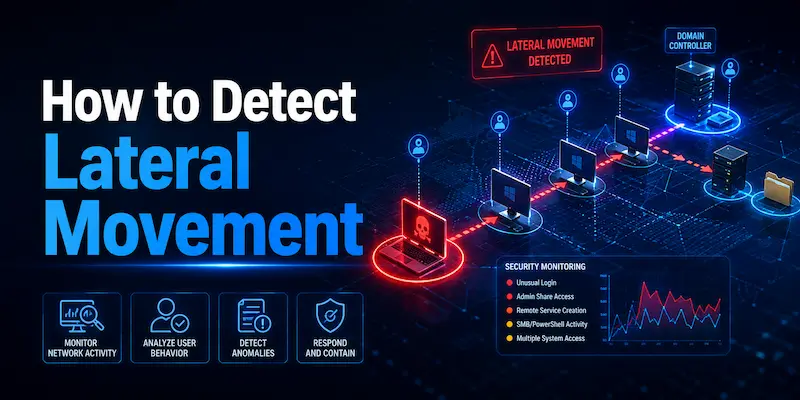
The following are the key indicators of lateral movement to monitor:
1. Anomalous Authentication Activity: Logins during off-peak hours, several unsuccessful tries across systems, or unexpected simultaneous logins using a single account.
2. Spikes in East-West Administrative Protocols: Unusual increases in internal traffic between internal endpoints across protocols like SMB, RDP, WMI, RPC, or SSH.
3. Abuse of Built-in Command-Line Tools: Running live-off-the-land programs on non-admin computers, such as PsExec, PowerShell, or net.exe.
4. LSASS Process Tampering & Memory Dumping: In order to gather credentials, unauthorized processes can access or dump memory from lsass.exe.
5. Unexpected Admin Share & Privilege Activity: Unexpected escalation to local administrator access or remote mounting of default admin shares (C$, ADMIN$).
How to Detect Lateral Movement Across Endpoints and Networks?
|
S.No. |
Factors |
How? |
|
1. |
Monitor East-West Network Traffic |
Look for odd SMB, RDP, or SSH connections traveling between non-server endpoints by examining internal traffic. |
|
2. |
Track LSASS and Credential Access Activity |
Keep an eye out for illegal process memory access that targets lsass.exe in order to stop credential dumping before it happens. |
|
3. |
Correlate Authentication & Service Creation Logs |
Compare unexpected remote logins to newly created Windows services (Event IDs 4624, 7045). |
|
4. |
Detect Living-off-the-Land Tool Abuse |
Keep an eye out for unusual PowerShell, WMI, or PsExec invocations in process execution command lines. |
|
5. |
Identify Network Segmentation & Boundary Violations |
Report attempts by unauthorized users to jump machines between subnets or get past internal firewalls. |
Using Authentication and Login Anomalies to Detect Lateral Movement
Monitoring internal network traffic for unusual logon patterns, such as abrupt surges in remote NTLM/Kerberos requests, off-hours access, or single accounts accessing many systems at once, is necessary to detect lateral movement through authentication anomalies.
In order to detect improper credential reuse across endpoints, security teams correlate Event IDs 4624 (successful logon) and 4672 (special privileges assigned) to isolate these suspicious pivots early.
How Does Threat Intelligence Improve Lateral Movement Detection?
Threat intelligence improves lateral movement detection in the following ways:
● Provides Context for Living-off-the-Land (LotL) Abuse: Separates benign daily IT programs from dangerous administrator command lines.
● Delivers Adversary TTP Mapping: Matches known MITER ATT&CK lateral movement playbooks with observed host behaviors.
● Enriches Indicators of Compromise (IOCs): Compares hashes and internal IP connections to global enemy infrastructure feeds.
● Prioritizes High-Risk Attack Pathways: Draws attention to fragile trust connections and known target assets that are frequently used in targeted intrusions.
● Reduces Detection Latency via Threat Hunting Queries: Provides pre-made hunting signatures (such as YARA-L and Sigma) to proactively search logs for covert lateral pivots.
How Does XDR Help Detect and Stop Lateral Movement?
|
S.No. |
Factors |
How? |
|
1. |
Cross-Layer Telemetry Correlation |
Creates a single, cohesive threat scenario by combining weak signals from endpoints, network logs, and identity providers. |
|
2. |
Identity-Aware Behavioral Analytics |
By identifying unusual user behavior, unexpected privilege usage, and implausible journey logons, it can identify hacked accounts. |
|
3. |
Full East-West Traffic Visibility |
Detects unwanted SMB, RDP, or SSH pivots by keeping an eye on internal lateral connections across non-perimeter networks. |
|
4. |
Automated Surgical Containment |
Revokes stolen credentials and instantly isolates infected hosts without pulling the rest of the company offline. |
|
5. |
AI-Driven Attack Timeline Mapping |
Allows security teams to monitor the extent of lateral movement by reconstructing the adversary's precise path in real time. |
How Do AI and Behavioral Analytics Detect Stealthy Lateral Movement?
AI and behavioral analytics detect stealthy lateral movement in the following ways:
a) Establishes Baseline User & Entity Profiles (UEBA): Scores deviations from taught behavioral norms to identify unusual logins and access patterns.
b) Detects Low-and-Slow Command Anomalies: Finds modest, infrequent usage of administrative tools, such as PowerShell, that avoids threshold notifications.
c) Maps East-West Graph Connections: Uses internal connection architecture to reveal previously unheard-of real-time machine-to-machine conversations.
d) Identifies Credential Abuse via Machine Learning: Detects the use of stolen credentials by analyzing concurrent access, session origin, and execution context.
e) Correlates Weak Signals Into Attack Sequences: Generates high-fidelity lateral movement alerts from small, isolated host and network anomalies.
The Role of Zero Trust in Blocking Lateral Movement
The following are the roles of zero trust in blocking lateral movement:
1. Enforces Least-Privilege Access: Limits machine and user permissions to prevent hacked accounts from accessing unapproved nearby systems.
2. Eliminates Implicit Network Trust: Requires rigorous verification for each cross-system link, treating all internal network communication as untrusted.
3. Implements Microsegmentation: Separates networks into separate tasks in order to physically prevent intruders from switching between subnets.
4. Validates Continuous Authentication: Requires regular identity and device health checks rather than allowing unrestricted access following the initial login.
5. Assumes Immediate Breach: Aggressively reduces the lateral blast radius while operating under the presumption that the perimeter is compromised.
Best Practices to Prevent Lateral Movement Before a Breach Spreads
|
S.No. |
Practices |
What? |
|
1. |
Implement Microsegmentation and Zero Trust Architecture |
To prevent unwanted traffic between internal systems, divide networks into stringent zones. |
|
2. |
Enforce Strict Privilege and Identity Governance |
Eliminate shared local administrator accounts, enforce MFA, and implement least-privilege access. |
|
3. |
Harden Endpoint Credentials and Session Security |
To prevent memory dumping, enable LLSASS protection (such as Credential Guard) and limit cached credentials. |
|
4. |
Restrict Dual-Homed Systems and Administrative Remote Access |
Strictly isolate jump boxes across network boundaries and disable any unnecessary remote services (RDP, WinRM). |
|
5. |
Monitor East-West Traffic with Continuous Behavioral Analytics |
Examine internal lateral connections to quickly identify unusual command-line execution and credential reuse. |
How to Respond When Lateral Movement Is Detected?
You can respond when lateral movement is detected in the following ways:
● Surgically Isolate Affected Endpoints: Cut off the affected machine's network connection right away while saving its memory for forensic analysis.
● Revoke and Reset Compromised Identity Sessions: Force password resets for all exposed accounts, terminate current tokens, and invalidate Kerberos tickets.
● Trace and Scrape the Lateral Trajectory: To find the patient-zero entry point, map the attacker's timeline backward; to reveal all pivoted nodes, map the timeline forward.
● Block Adversary Persistence Mechanisms: Unauthorized SSH keys, backdoor tools, malicious services, and freshly formed scheduled jobs should all be found and eliminated.
● Harden Internal Access Control Boundaries: To stop secondary lateral jumps, immediately implement emergency firewall rules and cancel broad subnet routing.
Conclusion: Stop Lateral Movement Before It Becomes a Major Breach
Now that we have talked about what Lateral Movement is, you might want to get your hands on a dedicated security solution from a reliable source. For that, you can go for ShieldXDR, a dedicated threat detection and response tool offered by Craw Security.
Businesses will be able to enhance their security with the help of ShieldXDR, which automatically detects anonymous cyber threats and deals with them in time. Thus, you will be able to feel secure in your work environment. What are you waiting for? Contact, Now!
Frequently Asked Questions
About Lateral Movement
1. What is lateral movement in cybersecurity?
In cybersecurity, lateral movement refers to the method by which attackers travel through a network once they have established an initial foothold in order to find and compromise valuable assets.
2. Why is lateral movement dangerous for organizations?
Lateral movement is dangerous for organizations for the following reasons:
a) Expands the Blast Radius,
b) Provides Unrestricted Access to High-Value Assets,
c) Extends Adversary Dwell Time,
d) Paves the Way for Mass Ransomware and Exfiltration, and
e) Disrupts Operational and Safety Boundaries.
3. How can organizations detect lateral movement?
Organizations can detect lateral movement in the following ways:
a) Analyze East-West Network Traffic,
b) Detect Authentication and Logon Anomalies,
c) Monitor Credential Access and Memory Access,
d) Audit Native Command-Line Executions, and
e) Deploy Behavioral Analytics and Identity Protections (UEBA).
4. What are the common signs of lateral movement?
The following are the common signs of lateral movement:
a) Anomalous Authentication and Concurrent Logons,
b) Unusual East-West Traffic Spikes,
c) Suspicious Command-Line Utility Execution,
d) LSASS Process Access and Memory Dumping, and
e) Unexpected Remote Service and Scheduled Task Creation.
5. Which tools can detect lateral movement attacks?
The following tools can detect lateral movement attacks:
a) Endpoint Detection and Response (EDR),
b) Network Detection and Response (NDR),
c) Identity Threat Detection and Response (ITDR),
d) Security Information and Event Management (SIEM), and
e) Extended Detection and Response (XDR).
6. How does XDR help detect lateral movement?
XDR helps detect lateral movement in the following ways:
a) Unified Cross-Layer Correlation,
b) Full East-West Traffic Visibility,
c) Identity-Aware Behavioral Analytics,
d) Command-Line & Living-off-the-Land Detection, and
e) Automated Containment & Timeline Mapping.
7. How does UEBA identify suspicious lateral movement?
UEBA identifies suspicious lateral movement in the following ways:
a) Establishes Baseline User and Entity Behavior,
b) Detects Abnormal Authentication and Credentials,
c) Surfaces Unusual Machine-to-Machine Connections,
d) Identifies Privilege Escalation and Usage, and
e) Correlates Anomalous Low-and-Slow Events.
8. How can privileged account abuse indicate lateral movement?
Privileged account abuse indicates lateral movement in the following ways:
a) Unusual Access to Sensitive Systems,
b) Concurrent Logons Across Endpoints,
c) Service Account Execution on Workstations,
d) Abnormal High-Privilege Command Usage, and
e) Creation of Unauthorized Temporary Privileges.
9. How can organizations prevent lateral movement after an initial compromise?
Organizations can prevent lateral movement after an initial compromise in the following ways:
a) Enforce Zero Trust and Microsegmentation,
b) Implement Least Privilege and Tiered Administration,
c) Harden Endpoint Memory and Credentials,
d) Restrict Administrative Protocols and Remote Access, and
e) Deploy Continuous Behavioral Monitoring (EDR/XDR).
10. What should security teams do when lateral movement is detected?
Security teams should do the following things when lateral movement is detected:
a) Surgically Isolate Affected Endpoints,
b) Revoke and Reset Exposed Identity Sessions,
c) Trace and Scrape the Lateral Trajectory,
d) Block Adversary Persistence and Tools, and
e) Harden Internal Access Control Boundaries.
Daksh
Cybersecurity expert and contributor at ShieldXDR, dedicated to sharing insights on threat detection, response, and overall digital security posture.