What Is Attack Surface Management?
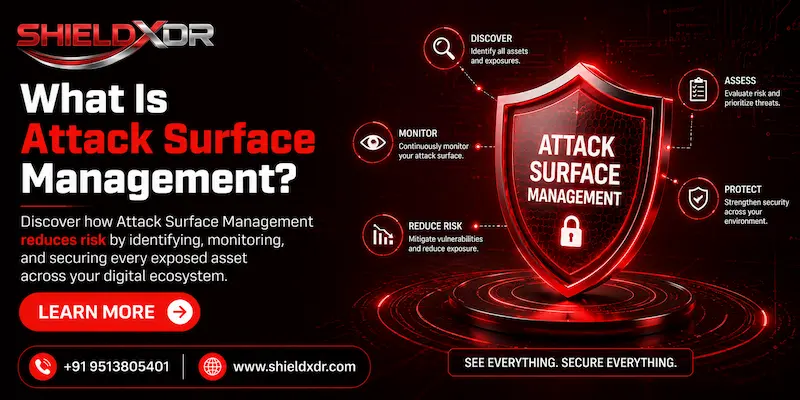
Do you know what Attack Surface Management is and how it can help organizations to improve their security measures to a greater level? If not, then you are at the right place. Here, we will talk about what attack surface management is and related benefits in detail.
Moreover, we will introduce you to a reliable XDR solution offered by a reputable VAPT service provider. What are we waiting for? Let’s get straight to the topic!
What Is Attack Surface Management (ASM)?
The ongoing process of finding, examining, and keeping an eye on an organization's whole digital footprint to spot exposed assets, configuration errors, and other security flaws is known as attack surface management, or ASM.
Security teams can address access points before hackers can take advantage of them thanks to ASM's real-time visibility into both known and unknown IT infrastructure, such as cloud services, exposed APIs, and distant endpoints.
By continuously reducing the routes that attackers can take into a network, it ultimately moves cybersecurity from reactive protection to proactive risk reduction. Let’s take a look at what Attack Surface Management is and how it helps in better security enhancement!
Attack Surface Management (ASM) vs. Vulnerability Management
|
S.No. |
Topics |
Factors |
What? |
|
1. |
Attack Surface Management (ASM) |
Scope & Visibility |
Continuously identifies and maps all digital assets, both internal and external, including IT infrastructure that is unknown, unmanaged, or hidden from the viewpoint of an outside-in attacker. |
|
Primary Objective |
Reduces the overall footprint available to adversaries by identifying weak attack vectors, misconfigurations, and exposed entry points throughout the whole business. |
||
|
2. |
Vulnerability Management (VM) |
Scope & Visibility |
Evaluates specific software vulnerabilities, missing updates, and security problems by scanning databases and known, managed internal assets. |
|
Primary Objective |
Evaluates and ranks known software flaws (such as CVEs) on systems that have been cataloged to direct patching and repair actions. |
Why Is Attack Surface Management Critical for Modern Businesses?
Attack surface management is critical for modern businesses for the following reasons:
1. Elimination of Shadow IT & Unmanaged Assets: Automatically finds assets that are rogue, hidden, or neglected before attackers take advantage of them.
2. Rapid Expansion of Modern Cloud Attack Surfaces: Constantly maps short-lived, rapidly changing multi-cloud workloads and APIs.
3. Shift from Reactive Patching to Proactive Exposure Reduction: Instead of waiting for vulnerability alerts, it proactively reduces attack vectors.
4. Protection Across Expanding Remote Work Ecosystems: Protects SaaS access points, residential networks, and off-network employee devices.
5. Meeting Regulatory Compliance & Sovereign Mandates: Guarantees constant asset visibility to meet requirements such as DPDP and CERT-In.
Common Risks Caused by an Unmanaged Attack Surface
The following are some common risks caused by an unmanaged attack surface:
● Exploitation of Unmanaged Shadow IT: Unmapped, abandoned, or rogue digital assets allow attackers to obtain illegal access.
● Exposed Credentials and Data Leaks: Identity-based breaches are encouraged by accessible database endpoints and leaked corporate login credentials.
● Cloud Misconfigurations and Open Storage Buckets: Sensitive information is publicly exposed due to misconfigured permissions and public cloud storage.
● Supply Chain and Third-Party Risks: Your main network is compromised by flaws in third-party APIs and linked vendor applications.
● Regulatory Non-Compliance and Severe Penalties: Exposure to unmonitored data results in legal penalties and regulatory infractions.

The Different Types of Attack Surfaces
|
S.No. |
Types |
What? |
|
1. |
Digital Attack Surface (External & Web-Facing) |
Comprises all domains, IP addresses, web applications, and open ports that are vulnerable to cyberattacks. |
|
2. |
Physical Attack Surface |
Includes USB drives, server rooms, unprotected endpoints, physical gear, and facility access points. |
|
3. |
Social Engineering/ Human Attack Surface |
Involves the use of phishing, impersonation, and credential theft to target workers and contractors. |
|
4. |
SaaS and Cloud Attack Surface |
Includes third-party SaaS application integrations, microservices, APIs, and multi-cloud environments. |
|
5. |
Third-Party & Supply Chain Attack Surface |
Comprises pooled digital supply chain assets, outsourced IT services, and linked vendor networks. |
How Does Attack Surface Management Work?
Attack surface management works in the following ways:
a) Continuous Discovery & Asset Identification: Finds and maps all known, unknown, and shadow IT assets by continuously scanning the internet.
b) Inventorying & Asset Categorization: Catalogs found assets according to ownership, asset type, and business criticality in a structured database.
c) Vulnerability & Exposure Analysis: Evaluates resources in real time to find software bugs, open ports, incorrect setups, and compromised passwords.
d) Risk Prioritization & Contextual Scoring: Prioritizes critical risks by ranking security issues according to their severity, threat intelligence, and exploitability.
e) Automated Remediation & Continuous Monitoring: Maintains constant monitoring of the digital ecosystem while initiating automated fix workflows or alarms.
Key Components of an Effective Attack Surface Management Program
The following are some key components of an effective attack surface management program:
1. Real-Time & Outside-In Asset Discovery: Finds all exposed, rogue, and forgotten digital assets by continuously scanning the internet from the viewpoint of an attacker.
2. Context-Aware Risk Scoring & Prioritization: Assesses vulnerabilities in conjunction with threat intelligence and asset criticality to identify the few problems that pose an urgent threat.
3. Continuous Cloud & Shadow IT Monitoring: Dynamically monitors the creation and modification of multi-cloud infrastructures, APIs, and illegitimate SaaS deployments.
4. Automated Remediation Workflows: Instantaneously initiates patching, port closures, or confinement actions by integrating directly with ticketing and security technologies.
5. Executive & Regulatory Compliance Reporting: Converts technical risk data into audit-ready reports and high-level security metrics for compliance and leadership organizations.
How AI and Automation Improve Attack Surface Management?
|
S.No. |
Factors |
How? |
|
1. |
Continuous & Autonomous Asset Discovery |
Without human assistance, AI agents continuously search the internet for hidden, transient, and shadow assets. |
|
2. |
Intelligent Risk Scoring & Contextual Prioritization |
Exposures are ranked by machine learning according to asset business value and real-time exploitability. |
|
3. |
Behavioral Anomaly & Zero-Day Detection |
AI algorithms find new zero-day entry points and unusual access patterns in digital assets. |
|
4. |
Automated Containment & Instant Remediation |
Playbooks immediately revoke compromised credentials, close open ports, and initiate real-time remedies. |
|
5. |
Alert Fatigue Relief & False-Positive Filtering |
By verifying risks before notifying security staff, predictive algorithms reduce noise. |
Best Practices for Strengthening Your Organization's Attack Surface
The following are best practices for strengthening your organization’s attack surface:
● Enforce Continuous Discovery & Shadow IT Mapping: To quickly identify and categorize unmonitored digital assets, run continuous scans.
● Implement Zero Trust & Strict Access Controls: Strictly enforce least-privilege access at all entry points and mandate multi-factor authentication.
● Transition to Risk-Based Patching & Prioritization: Instead of using general vulnerability listings, concentrate patching efforts on actively exploited exposures.
● Decommission Legacy & Ephemeral Assets Promptly: To lessen exposure, get rid of out-of-date software, idle cloud instances, and unused subdomains.
● Mitigate Third-Party & Supply Chain Exposure: Enforce stringent security
standards throughout external integrations and audit related vendor access.
How to Choose the Right Attack Surface Management Solution?
You can choose the right attack surface management solution in the following ways:
a) Passive & Active Discovery: To find hidden and shadow assets, choose a technology that combines active probes with non-intrusive public scanning.
b) Contextual & Exploitability-Based Risk Scoring: Instead of using raw CVSS ratings, select solutions that use asset criticality and real-time threat intelligence to prioritize warnings.
c) Multi-Cloud, SaaS, & Third-Party Surface Coverage: Assure complete visibility over vendor ecosystems, SaaS applications, external APIs, and hybrid cloud infrastructures.
d) Seamless Integration with Existing SOC Workflows: Select a platform that integrates with your ticketing, vulnerability management, SIEM, and SOAR systems natively.
e) Continuous Monitoring & Automated Reverification: Choose continuous scanning, which verifies that risks are completely eliminated by automatically re-checking fixed defects.
Future Trends in Attack Surface Management
|
S.No. |
Trends |
What? |
|
1. |
Rise of Cyber Asset Attack Surface Management (CAASM) |
Internal device, cloud, and identity inventories are combined into a single source of truth through API-driven ingestion. |
|
2. |
Shift to Continuous Threat Exposure Management (CTEM) |
Expands EASM into a five-stage, organized framework for prioritized risk reduction and ongoing validation. |
|
3. |
Agentic AI & Automated Exploitation Proofs |
Before warning teams, autonomous AI agents continuously evaluate attack routes and confirm exploitability to demonstrate actual risk. |
|
4. |
Expansion into AI & Supply Chain Surface Coverage |
Extends asset discovery to keep an eye on third-party SaaS integrations, LLM APIs, and shadow AI models. |
|
5. |
Convergence with Detection and Response Platforms |
ASM instantly initiates containment upon exposure detection by integrating natively with XDR, SIEM, and SOAR platforms. |
Conclusion
Now that we have talked about what Attack Surface Management is, you might want to get a dedicated security tool to protect your working environment from online threats. For that, you can go for ShieldXDR, a dedicated threat detection and response tool offered by Craw Security.
Organizations will feel more secure with ShieldXDR, which will automatically detect unauthorized access to systems and networks to protect their device against online threats. What are you waiting for? Contact, Now!
Frequently Asked Questions
About Attack Surface Management
1. What is Attack Surface Management (ASM)?
The ongoing process of identifying, evaluating, and keeping an eye on an organization's whole digital footprint to safeguard exposed assets, misconfigurations, and entry points before attackers can take advantage of them is known as attack surface management, or ASM.
2. Why is Attack Surface Management important for cybersecurity?
Attack surface management is important for cybersecurity for the following reasons:
a) Eliminates Shadow IT & Hidden Assets,
b) Prevents Exploitation of Misconfigurations,
c) Enables Proactive Risk Reduction,
d) Prioritizes Critical Threats, and
e) Secures Expanding Digital Ecosystems.
3. What are the different types of attack surfaces?
The following are the different types of attack surfaces:
a) Digital Attack Surface (External & Web-Facing),
b) Physical Attack Surface,
c) Social Engineering / Human Attack Surface,
d) SaaS and Cloud Attack Surface, and
e) Third-Party & Supply Chain Attack Surface.
4. How does Attack Surface Management work?
Attack surface management works in the following ways:
a) Continuous Discovery,
b) Asset Cataloging & Categorization,
c) Exposure & Vulnerability Analysis,
d) Risk Prioritization, and
e) Remediation & Continuous Monitoring.
5. What is the difference between Attack Surface Management and Vulnerability Management?
While Vulnerability Management assesses and ranks known software defects and patches on cataloged internal assets, Attack Surface Management continuously finds and maps all unknown and exposed external assets around an organization's perimeter.
6. What are the key features of an Attack Surface Management solution?
The following are the key features of an attack surface management solution:
a) Continuous & Outside-In Asset Discovery,
b) Asset Inventorying & Contextual Classification,
c) Real-Time Exposure & Misconfiguration Detection,
d) Context-Aware Risk Prioritization, and
e) Automated Remediation & SOC Integration.
7. Which industries need Attack Surface Management the most?
The following industries need attack surface management the most:
a) Banking, Financial Services, & Insurance (BFSI),
b) Healthcare,
c) Manufacturing & Industrial Technology,
d) IT, Software, & Cloud Services, and
e) Government & Critical Infrastructure.
8. Can AI improve Attack Surface Management?
Yes, by automating continuous asset discovery, forecasting exploitability in real time, and removing false positives to initiate immediate remediation before vulnerabilities are exploited, AI enhances Attack Surface Management.
9. What are the best Attack Surface Management tools available today?
The following are the best attack surface management tools available today:
a) ShieldXDR,
b) Palo Alto Networks Cortex Xpanse,
c) CyCognito,
d) Microsoft Defender EASM, and
e) CrowdStrike Falcon Exposure Management.
10. How can organizations reduce their attack surface effectively?
Organizations can reduce their attack surface effectively in the following ways:
a) Maintain Continuous Discovery & Map Shadow IT,
b) Decommission Legacy & Idle Assets,
c) Enforce Zero Trust & Least Privilege,
d) Transition to Risk-Based Patching, and
e) Secure Third-Party & Supply Chain Entry Points.
Daksh
Cybersecurity expert and contributor at ShieldXDR, dedicated to sharing insights on threat detection, response, and overall digital security posture.