What Is SOC Automation and How Does It Reduce Analyst Burnout?
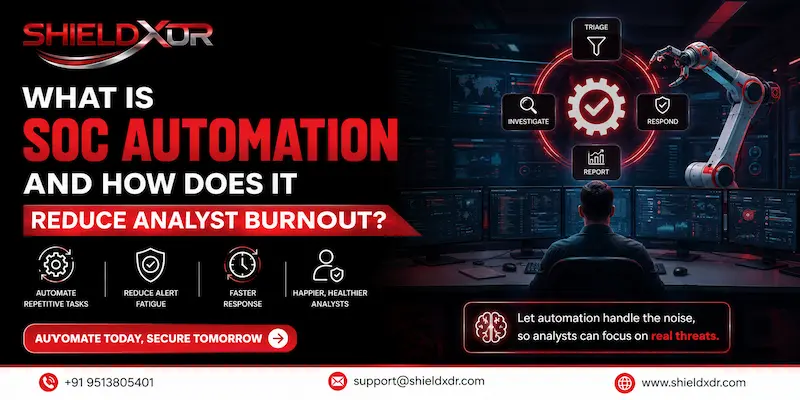
Do you know what SOC Automation is and how it can help organizations to reduce analyst burnout and increase security? If not, then you are at the right place. Here, we will talk about what SOC automation is and related benefits in detail.
Moreover, we will introduce you to a reliable XDR solution offered by a reputable VAPT service provider. What are we waiting for? Let’s get started!
What Is SOC Automation?
Software, artificial intelligence, and pre-written playbooks are used by SOC automation to automatically carry out routine cybersecurity operations, like gathering alarm data and carrying out first threat triage.
It makes it possible for security operations centers to analyze and contain threats considerably more quickly by managing standard incident response procedures without the need for human participation.
In the end, this relieves analysts of alert fatigue, allowing them to concentrate their skills on intricate, high-priority security investigations. Let’s take a look at what SOC Automation is, its uses, its features, and its benefits for organizations in the IT Industry!
Core Technologies Behind SOC Automation: SIEM, SOAR, AI, and Machine Learning
The following are the core technologies behind SOC automation:
1. SIEM: Centralizes and correlates log data throughout the network to instantly identify possible security risks.
2. SOAR: Uses standardized playbooks to coordinate operations across various security tools and automate incident response workflows.
3. AI: Uses extensive dataset analysis to make intelligent decisions, recognize intricate assault patterns, and reason on its own.
4. Machine Learning: Establishes baselines, finds abnormalities, and forecasts possible dangers over time by analyzing past security data.
Why Has SOC Automation Become Essential for Today's Security Operations Centers?
|
S.No. |
Factors |
Why? |
|
1. |
Overwhelming Alert Volume |
Delivers thousands of messages per day to security teams, making it nearly impossible to manually examine each alarm. |
|
2. |
High Rate of False Positives |
Requires analysts to continuously look into non-threatening system noise, which consumes their time and attention. |
|
3. |
Sophisticated and Fast-Moving Cyberattacks |
Needs automated, split-second reaction times to stop sophisticated threats before serious harm is done. |
|
4. |
Persistent Talent Shortages and Burnout |
Helps retain worn-out employees in the face of a global cybersecurity labor shortage by delegating repetitive manual chores to automation. |
|
5. |
Complex Tool Sprawl |
Eliminates operational silos by integrating several security systems into a single, efficient workflow. |

How Does SOC Automation Work to Detect, Investigate, and Respond to Cyber Threats?
SOC automation works to detect, investigate, and respond to cyber threats in the following ways:
● Continuous Ingestion and Detection: It collects security data from many networks and instantly flags possible dangers using pre-established procedures.
● Automated Data Enrichment: Provides context for flagged warnings without requiring manual research by instantly retrieving threat intelligence, IP reputation, and contextual user data.
● Smart Alert Triage and Prioritization: Allows analysts to quickly concentrate on genuine high-priority risks by scoring and filtering alerts according to risk severity.
● Playbook Execution for Rapid Containment: Initiates automated reaction processes to instantly block attacker IPs or isolate compromised assets.
● Streamlined Investigation and Reporting: Creates thorough audit logs and incident timelines to make compliance and post-incident analysis easier.
Top Security Operations Center Tasks That Can Be Automated Effectively
The following are some of the top SOC tasks that can be automated effectively:
a) Alert Triage and Enrichment: Immediately assigns severity rankings to identify serious threats by correlating incoming warnings with threat intelligence.
b) Phishing Email Analysis and Quarantine: Checks for harmful links and suspicious email headers, then automatically deletes emails that have been detected from user inboxes.
c) Incident Containment Actions: Automatically bans malicious IP addresses at the firewall, deactivates compromised user accounts, and isolates infected endpoints.
d) Vulnerability Scanning and Patch Context: Provides analysts with instant perspective on system exposure by mapping asset vulnerabilities against active security alerts.
e) Ticket Creation and Documentation: Maintains transparent audit trails by automatically opening, updating, and logging incident information in IT service management platforms.
Human-in-the-Loop vs. Fully Automated Response Strategies
|
S.No. |
Topics |
Factors |
What? |
|
1. |
Human-in-the-Loop (HITL) Strategy |
Guided Decision-Making |
Automation collects context and plans reaction activities, but it doesn't take crucial steps like shutting down a main database unless an analyst gives their clear consent. |
|
Risk & Impact Reduction |
It is perfect for high-severity disasters affecting vital business infrastructure since it prevents unintentional operational downtime or false-positive disruptions. |
||
|
2. |
Fully Automated Response Strategy |
Zero-Delay Containment |
In milliseconds, playbooks can thwart fast-moving threats by blocking malicious IPs or isolating infected endpoints without the need for human interaction. |
|
Low-Risk Scalability |
Eliminates the need for analysts to do routine triage operations by automatically handling repetitive, well-defined event categories (such as quarantining typical phishing emails). |
How Does SOC Automation Reduce Analyst Burnout and Improve Team Productivity?
SOC automation reduces analyst burnout and improves team productivity in the following ways:
1. Eliminates Repetitive "Click-Ops": Uses automated workflows to replace time-consuming manual clicks and data copying.
2. Dramatically Reduces Alert Fatigue: Eliminates harmless noise so that analysts only deal with real, urgent dangers.
3. Shortens Response and Investigation Times: Uses automated playbooks to reduce the time it takes to contain threats from hours to seconds.
4. Shifts Focus to High-Value Work: Allows analysts to focus on strategic projects, skill development, and proactive threat hunting.
5. Provides Clear, Structured Workflows: Leads groups through defined procedures to lower tension and avoid expensive mistakes.
Key Metrics and KPIs to Measure SOC Automation Success
The following are some key metrics and KPIs to measure SOC automation success:
● Mean Time to Detect (MTTD): Evaluates the speed at which your automated systems process data, correlate events, and identify any security issues.
● Mean Time to Respond/ Acknowledge (MTTR): Shows the speed of automated playbooks by tracking the time saved from the creation of the first alarm to the containment of the threat.
● Alert Noise Reduction Rate: Calculates the proportion of redundant warnings and false positives that are automatically removed before they are seen by human analysts.
● Percentage of Automated Tasks/ Playbook Execution Rate: Determines the percentage of routine tasks (such as IP blocking or enrichment) that are completed without human assistance.
● Analyst Workload and Burnout Index: Evaluates improvements in work satisfaction and capacity by comparing increases in tier-1 alert volumes per analyst with retention rates.
Key Benefits of SOC Automation for Businesses of All Sizes
|
S.No. |
Benefits |
How? |
|
1. |
Faster Threat Response & Risk Reduction |
Reduces operational downtime and avoids expensive data breaches by quickly identifying cyber threats. |
|
2. |
Cost Efficiency & Resource Optimization |
Maximizes security return on investment by enabling current teams to manage increased volumes without increasing manpower. |
|
3. |
Consistent & Standardized Security Operations |
Removes human mistakes by carrying out compliant, repeatable playbooks for each security occurrence. |
|
4. |
Improved Retention & Analyst Job Satisfaction |
Keeps qualified security personnel motivated and employed longer by eliminating tedious jobs, which lowers burnout. |
|
5. |
Enhanced 24/7 Operational Resilience |
Keeps up 24/7 automatic threat detection and response without the need for continual midnight staffing. |
Common Challenges in Implementing SOC Automation and How to Overcome Them
The following are some common challenges in implementing SOC automation and how to overcome them:
a) Complex Security Tool Integration: Choose open-architecture platforms or standardize on native pre-built connections to get over API compatibility problems.
b) Fear of False Positive Disruption: Start with "Human-in-the-Loop" approvals before moving to fully automated actions to reduce business downtime.
c) Poorly Defined Processes and Playbooks: Before creating playbooks, carefully plan out and improve manual response processes to prevent automating disorganized workflows.
d) Skills Gap and Scripting Overhead: Adopting contemporary low-code or no-code SOAR platforms that eliminate the requirement for bespoke Python scripts might ease training burdens.
e) Over-Automation and Alert Suppression: Establish stringent auditing procedures and routinely test playbooks against known attack vectors to avoid blind spots.
Best Practices for Successfully Deploying SOC Automation in Your Organization
The following are best practices for successfully deploying SOC automation in your organization:
1. Start Small and Scale Gradually: Before taking on intricate, multi-stage procedures, automate basic, high-frequency operations.
2. Standardize Processes Before Automating: Before creating automated playbooks, record and improve manual reaction processes.
3. Adopt a "Human-in-the-Loop" Approach Initially: Until playbook accuracy is completely demonstrated, require analyst permission for important activities.
4. Focus on Integration and Data Quality: Make sure all security tools have smooth API connections and clear contextual data.
5. Continuously Monitor, Audit, and Refine Playbooks: Review automatic activities on a regular basis to adjust to changing threat vectors and system modifications.
The Future of SOC Automation: AI-Driven SOCs, Autonomous Security, and Emerging Trends
Agentic AI and self-healing systems that independently identify, contextualize, and eliminate sophisticated cyberthreats in real time without the need for strict playbooks are essential to the future of SOC automation.
Next-generation SOCs will quickly adjust to new attack vectors by combining hyper-automation with predictive intelligence, transforming analysts from reactive responders to strategic defenders.
Conclusion
Now that we have talked about what SOC Automation is, you might also want to get your hands on dedicated security measures from a reliable source. For that, you can go for ShieldXDR, a dedicated threat detection and response tool offered by Craw Security.
ShieldXDR can help businesses to work as a dedicated firewall to detect all abnormalities and deal with cyber threats with ease. Thus, you can feel secure while working online. What are you waiting for? Contact, Now!
Frequently Asked Questions
About SOC Automation
1. What is SOC automation, and how does it work?
SOC automation quickly contains threats with little human interaction by using software and AI to automatically gather data, prioritize alarms, and carry out response workflows.
2. How does SOC automation reduce security analyst burnout?
SOC automation reduces security analyst burnout in the following ways:
a) Filters Out Noise and False Positives,
b) Eliminates Tedious "Click-Ops",
c) Accelerates Threat Contextualization,
d) Reduces High-Stakes On-Call Stress, and
e) Enables High-Value Strategic Work.
3. What are the biggest benefits of implementing SOC automation?
The following are the biggest benefits of implementing SOC automation:
a) Ultra-Fast Threat Containment,
b) Dramatic Reduction in Analyst Fatigue,
c) Scalable Cost & Resource Efficiency,
d) Consistent, Error-Free Operations, and
e) Continuous 24/7 Resilience.
4. Which SOC tasks can be automated without human intervention?
It is possible to completely automate high-volume, low-risk processes without the need for human intervention, such as screening innocuous alarms, quarantining typical phishing emails, collecting threat intelligence, and blocking known malicious IPs at the firewall.
5. What is the difference between SOC automation and SOAR?
While SOAR (Security Orchestration, Automation, and Response) is the specific software platform used to carry out SOC automation across many tools, SOC automation is the general concept of automating security operations center tasks.
6. Can SOC automation replace cybersecurity analysts completely?
No, SOC automation cannot fully replace analysts; instead, it is intended to manage monotonous duties, freeing up human experts to concentrate on intricate decision-making, strategic threat hunting, and nuanced incident investigation.
7. How do AI and machine learning enhance SOC automation?
AI and machine learning enhance SOC automation in the following ways:
a) Dynamic Behavioral Anomaly Detection,
b) Intelligent Threat Triage and Scoring,
c) Autonomous Playbook Execution,
d) Predictive Incident Correlation, and
e) Continuous Self-Learning.
8. What are the common challenges of deploying SOC automation?
The following are the common challenges of deploying SOC automation:
a) Complex Tool Integration,
b) Risk of Business Disruption from False Positives,
c) Poorly Defined Manual Processes,
d) Skill Gaps and Custom Script Maintenance, and
e) Alert Blind Spots and Over-Suppression.
9. Which industries benefit the most from SOC automation solutions?
The following industries benefit the most from SOC automation solutions:
a) Financial Services & Banking,
b) Healthcare & Life Sciences,
c) E-Commerce & Retail,
d) Critical Infrastructure & Energy, and
e) Managed Security Service Providers (MSSPs).
10. How can organizations choose the right SOC automation platform?
Organizations can choose the right SOC automation platform in the following ways:
a) Integration Depth and Ecosystem Compatibility,
b) Low-Code/No-Code Flexibility,
c) Advanced AI and Smart Orchestration,
d) Granular Governance and Human-in-the-Loop Controls, and
e) Time-to-Value and Scalability.
Daksh
Cybersecurity expert and contributor at ShieldXDR, dedicated to sharing insights on threat detection, response, and overall digital security posture.