
Do you know what AI Detection in XDR Security is, and the benefits for organizations? If not, then you are at the right place. Here, we will talk about AI-based XDR Security, its uses, and benefits for the users in detail.
Moreover, we will introduce you to a reputed VAPT service provider offering a dedicated XDR security solution. What are we waiting for? Let’s get started!
What Is XDR Security with AI Detection?
An innovative security architecture called Extended Detection and Response (XDR) with AI detection automatically aggregates and evaluates data from an organization's whole digital ecosystem, including endpoints, networks, and cloud environments.
In order to proactively search for hidden dangers and correlate seemingly unrelated security events in real time, the platform integrates artificial intelligence and machine learning.
By quickly differentiating background noise from real cyberattacks, this combination significantly lessens alert fatigue for security professionals and allows for quick, automated containment before damage is done.
Let’s take a look at what AI Detection in XDR Security is and how it can help organizations to protect themselves against AI-based threats!
What is AI Detection in Cybersecurity Systems?
The application of machine learning algorithms and behavioral analytics to continuously monitor system data and spot anomalies that indicate a cyber threat is known as artificial intelligence (AI) detection in cybersecurity.
It enables platforms to anticipate, identify, and neutralize complex zero-day exploits and insider threats in real time by evolving to recognize new attack patterns without depending on static signatures.
How Traditional XDR Shortfalls Led to AI Integration?
|
S.No. |
Factors |
How? |
|
1. |
Overwhelming Alert Fatigue |
Analysts were inundated with disjointed signals from legacy systems, which obscured important dangers in a never-ending stream of background noise. |
|
2. |
Inability to Detect "Zero-Day" and Fileless Attacks |
New, memory-resident attacks that left no conventional file footprint were entirely overlooked by signature-based techniques. |
|
3. |
Siloed Data and Poor Contextual Correlation |
Security tools that were fragmented were unable to make the connections between subtle, related attack phases in various environments. |
|
4. |
Slow, Manual Incident Investigation |
Attack timelines had to be manually assembled by human teams, which delayed crucial containment while threats proliferated. |
|
5. |
Rigid, Reactive Security Postures |
Organizations were unable to adjust to changing, dynamic hacker techniques because security policies relied on set, historical configurations. |
Why AI Detection is Essential for Modern XDR Platforms?
AI detection is essential for modern XDR platforms for the following reasons:
1. Smarter Behavioral Baselines: AI creates a dynamic baseline of typical network and user activity, making it simple to quickly identify even the smallest irregularities.
2. Proactive Zero-Day Discovery: AI finds and stops completely new, never-before-seen exploits by examining intent and patterns instead of static signatures.
3. Intelligent Threat Contextualization: AI intelligently maps out the full death chain by piecing together fragmented telemetry from endpoints, networks, and clouds.
4. Drastic Reduction in Alert Fatigue: It ensures that SOC teams only concentrate on high-fidelity, critical threats by cleverly removing false positives and background noise.
5. Accelerated, Automated Response: In milliseconds, far before human intervention is feasible, AI initiates instantaneous, automated playbooks to isolate compromised hosts and eliminate threats.
How AI Detection Strengthens XDR Security Platforms?
AI Detection can strengthen XDR Security Platforms in the following ways:
● Unifies Fragmented Telemetry: AI serves as the central brain that immediately unifies disparate data flows from endpoints, networks, and clouds into a single, coherent chronology.
● Eradicates False Positives: AI eliminates innocuous background noise by continuously learning contextual context, allowing security professionals to concentrate solely on actual dangers.
● Spots Behavioral Anomalies: By identifying minute variations from typical user and device activity, it finds insider threats and covert, fileless attacks.
● Accelerates Incident Response: AI completely outpaces human attackers by initiating automatic playbooks that isolate compromised hosts and stop malicious traffic in milliseconds.
● Predicts Future Attack Vectors: AI foresees and strengthens vulnerabilities before they may be exploited by examining past threat data and current worldwide hacker tendencies.
Key Benefits of AI Detection in XDR Security
|
S.No. |
Benefits |
How? |
|
1. |
Real-Time Threat Correlation |
AI quickly connects disparate signals from your network, cloud, and endpoints to show the whole extent of a current assault. |
|
2. |
Dramatic Reduction in False Positives |
AI eliminates harmless background noise by learning what typical activity looks like, allowing your team to concentrate on actual threats. |
|
3. |
Proactive Defense Against Unknown Threats |
AI examines behavior to prevent new "zero-day" exploits before they appear, rather than waiting for known signs. |
|
4. |
Automated, Lightning-Fast Containment |
In milliseconds, AI initiates quick, automatic reactions to isolate compromised devices and stop threats. |
|
5. |
Enhanced SOC Efficiency and Scalability |
Security operations centers can manage enormous data volumes without experiencing burnout because it handles the laborious task of manual triaging. |
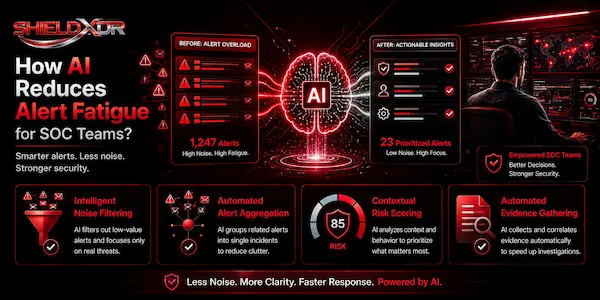
How AI Reduces Alert Fatigue for SOC Teams?
AI can reduce alert fatigue for SOC Teams in the following ways:
a) Intelligent Noise Filtering: To automatically suppress harmless, recurrent false positives that clog dashboards, AI continuously learns the typical behavior of your network.
b) Automated Alert Aggregation: AI combines relevant notifications into a single, comprehensive incident ticket rather than sending out hundreds of separate alerts for a single event.
c) Contextual Risk Scoring: AI shows analysts exactly what to look into first by prioritizing the threat queue by rating alerts according to severity and business effect.
d) Automated Evidence Gathering: The solution eliminates the need for analysts to do laborious manual search loops by automatically handling the laborious task of retrieving logs and user context.
e) Self-Healing False Positives: AI ensures that the system organically becomes smarter and quieter by using machine learning to dynamically modify its own detection algorithms over time.
Common Use Cases of AI Detection in XDR
The following are some common use cases of AI detection in XDR:
1. Ransomware Detection Using AI Detection: AI detects the precise moment when malicious shadow copy deletions or mass file encryption start, and it immediately stops the activity in its tracks.
2. Insider Threat Detection with AI Detection: By spotting odd efforts at data exfiltration or unauthorized access to confidential company vaults, it flags compromised or malevolent workers.
3. Phishing Prevention Through AI Detection: AI detects complex social engineering and spoofing attempts by analyzing email intent, sender behavior, and subtle anomalies in real time.
4. Cloud Security Monitoring with AI Detection: In order to prevent data leaks, it continuously checks multi-cloud systems for illegal API calls, storage configuration errors, and abrupt resource spin-ups.
Automated Incident Response and Playbooks
Automated incident response and playbooks are AI-driven, pre-configured routines that carry out immediate defensive steps, such as removing user access or isolating compromised hosts, as soon as a threat is confirmed.
These smart playbooks contain complex threats in milliseconds by eliminating human latency, changing the security team's function from desperate damage control to strategic monitoring.
What is ShieldXDR?
Craw Security's ShieldXDR is a centralized cybersecurity solution that combines network, cloud environment, and endpoint monitoring into a unified dashboard. It simplifies security operations by automatically correlating data feeds to identify zero-day exploits, suppress false positives, and initiate automated incident containment. It is powered by artificial intelligence, machine learning, and behavioral analytics.
Benefits of ShieldXDR for Organizations
The following are some benefits of ShieldXDR for organizations:
● Complete Visibility Across Environments: It removes security blind spots by combining data from endpoints, networks, and clouds into a single pane of glass.
● Proactive Threat Detection: It uses behavioral AI to detect and stop complex, zero-day assaults before they can do any harm.
● Minimized Operational Downtime: It rapidly isolates risks by triggering automated playbooks, ensuring uninterrupted company activities.
● Relief from Alert Fatigue: It allows analysts to fully concentrate on verified, high-priority threats by grouping related events and eliminating background noise.
● Simplified Compliance Management: It easily creates the necessary regulatory audit trails by continually monitoring and recording enterprise-wide activity.
Industries that can go for ShieldXDR
|
S.No. |
Industries |
Why? |
|
1. |
Healthcare |
Protects vital medical IoT devices and sensitive electronic health records (EHR) from ransomware attacks while adhering to stringent HIPAA regulations. |
|
2. |
Banking and Financial Services |
Satisfies strict international fiscal regulatory norms, safeguards high-value financial transactions, and stops sophisticated data exfiltration. |
|
3. |
E-Commerce and Retail |
Protects vast amounts of consumer payment information from websites, cloud-based inventory, and dispersed point-of-sale (POS) terminals. |
|
4. |
Manufacturing and Supply Chain |
Protects linked supply chain systems and operational technology (OT) from interruptions that could stop production processes. |
|
5. |
Government and Public Sector |
Protect highly private citizen data, municipal systems, and sensitive national infrastructure from state-sponsored cyberattacks. |
Future of AI Detection in XDR Security Systems
The shift from reactive analytics to autonomous self-healing environments powered by generative AI and predictive deep learning will determine the future of AI detection in XDR security systems.
In addition to anticipating intricate, multi-phase cyberattacks before they occur, these next-generation technologies will be able to dynamically rewrite security policies and isolate threats without the need for human interaction.
Conclusion: Strengthening XDR with AI Detection
Now that we have talked about what AI Detection in XDR Security is, you might want to get a dedicated AI-based XDR solution for yourself as well. For that, you can go for ShieldXDR, a dedicated threat detection & response tool offered by Craw Security.
The amazing ShieldXDR can automatically detect & respond to unknown and unauthorized malicious access. It can reduce the time for dealing with cyber attacks. What are you waiting for? Contact, Now!
Frequently Asked Questions
About AI Detection in XDR Security
1. What is AI detection in XDR security platforms?
The use of machine learning and behavioral analytics to continually monitor unified data across endpoints, networks, and cloud environments in order to automatically identify and eliminate sophisticated, concealed cyberthreats in real time is known as AI detection in XDR security platforms.
2. How does AI detection improve XDR security?
AI detection can improve XDR security in the following ways:
a) Cross-Layer Data Correlation,
b) Behavior-Based Anomaly Detection,
c) Drastic Reduction in Alert Fatigue,
d) Instantaneous Automated Response, and
e) Proactive Zero-Day Hunting.
3. Why is AI detection important for modern cybersecurity?
AI detection is important for modern cybersecurity for the following reasons:
a) Combats Sophisticated Zero-Day Exploits,
b) Erases Human Blind Spots with Massive Scale,
c) Slashes Attacker Dwell Time via Automation,
d) Solves the Alert Fatigue Crisis, and
e) Identifies Corrupted Insiders and Credential Theft.
4. How does AI detection help reduce false positives in XDR?
AI detection can help reduce false positives in XDR in the following ways:
a) Dynamic Behavioral Baselines,
b) Multi-Vector Contextual Analysis,
c) Continuous Machine Learning Feedback,
d) Environmental Contextual Awareness, and
e) Historical Data Comparison.
5. Can AI detection identify zero-day threats in XDR systems?
Yes, rather than depending on static, pre-existing threat profiles, AI detection detects zero-day attacks in XDR systems by utilizing behavioral analytics and machine learning to identify malicious patterns and intent in real time.
6. How does AI detection support real-time threat response in XDR?
AI detection can support real-time threat response in XDR in the following ways:
a) Instantaneous Attack Correlation,
b) Automated Playbook Triggering,
c) Context-Aware Micro-Segmentation,
d) Live Behavior-Based Blocking, and
e) Dynamic Threat Prioritization.
7. What role does machine learning play in AI detection for XDR?
Machine learning plays the following roles in AI detection for XDR:
a) Continuous Behavioral Baselining,
b) Dynamic Threat Classification,
c) Supervised Alert Triage,
d) Unsupervised Clustering of Attack Chains, and
e) Adaptive Rule Optimization.
8. How does AI detection improve behavioral analytics in XDR security?
AI detection can improve behavioral analytics in XDR security in the following ways:
a) Establishes Dynamic Behavioral Baselines,
b) Detects Low-and-Slow Attack Campaigns,
c) Identifies Fileless and Living-off-the-Land Threats,
d) Contextualizes User and Entity Behavior Analytics (UEBA), and
e) Adapts and Self-Tunes to Environmental Shifts.
9. What are the main benefits of using AI detection in XDR platforms?
The following are the main benefits of using AI detection in XDR platforms:
a) Holistic Cross-Layer Threat Correlation,
b) Drastic Reduction in Alert Fatigue,
c) Proactive Defenses Against Zero-Day Exploits,
d) Instantaneous, Automated Containment, and
e) Enhanced Detection of Insider Threats and Hijacked Accounts.
10. What challenges come with implementing AI detection in XDR security systems?
The following challenges come with implementing AI detection in XDR security systems:
a) Data Quality and Ingestion Dependency,
b) The "Black Box" Explainability Problem,
c) Model Drift and Evolving Environments,
d) Adversarial AI Evasion Tactics, and
e) Over-Reliance and Automation Risks.
Read More: