How to Choose the Right XDR Platform for Your Organization?
Do you know how XDR Platform can help organizations protect them against future data & financial losses? If not, then you are at the right place. Here, we will talk about what the XDR platform has to offer to needy organizations.
Moreover, we will introduce you to a reliable XDR platform offered by a reputable VAPT service provider. What are we waiting for? Let’s get straight to the topic!
What is XDR?
A comprehensive security solution called XDR (Extended Detection and Response) automatically gathers and correlates threat information from email, cloud environments, networks, and endpoints.
Dismantling conventional security silos, it gives security teams comprehensive insight and a centralized console to identify complex attacks that evade independent solutions. This makes it possible for businesses to quickly identify covert threats, expedite incident investigations, and coordinate quick, automated reaction measures from a single control point. Let’s take a look at what the XDR Platform is, its features, uses, and benefits for organizations!
Why XDR Matters?
|
S.No. |
Factors |
Why? |
|
1. |
Breaks Down Security Silos |
By automatically combining data from endpoints, networks, cloud, and email, it reveals sophisticated assaults that lurk in the spaces between independent technologies. |
|
2. |
Accelerates Threat Detection |
It reduces the amount of time cybercriminals can remain undiscovered within your network by rapidly highlighting real, high-priority threats through the use of AI to correlate warnings. |
|
3. |
Eliminates Alert Fatigue |
It allows security professionals to concentrate on solving issues rather than chasing ghosts by combining hundreds of disorganized, disconnected alerts into a single, coherent timeline. |
|
4. |
Drives Automated Responses |
It allows for quick, well-coordinated containment steps, such as blocking a malicious IP address across the firewall and isolating a compromised laptop. |
|
5. |
Optimizes Security Operations |
By consolidating visibility and management into a single console, it streamlines workflows and enables lean IT teams to operate more quickly and intelligently without requiring a large budget. |
What does an XDR Platform do?
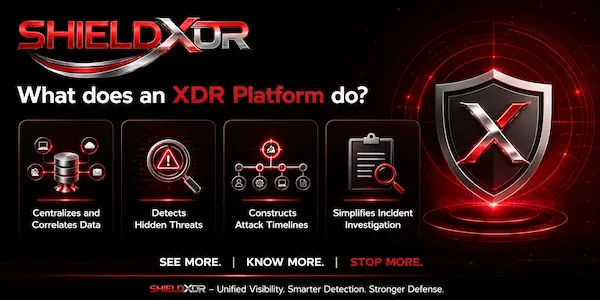
The XDR platform does the following tasks:
1. Centralizes and Correlates Data: It automatically compiles and connects security telemetry from email, networks, endpoints, and the cloud into a single view.
2. Detects Hidden Threats: It uses threat information and advanced analytics to identify complex, multi-stage threats that evade stand-alone security systems.
3. Constructs Attack Timelines: To demonstrate precisely how a breach began and where it spread, it combines disparate events into a coherent, chronological narrative.
4. Orchestrates Coordinated Responses: It immediately contains and eliminates a threat by initiating automatic defense operations throughout your whole infrastructure.
5. Simplifies Incident Investigation: By removing the need to switch between various tools, it offers a consolidated dashboard that enables analysts to respond to alarms more quickly.
Key Benefits of Implementing an XDR Solution
The following are some key benefits of implementing an XDR solution:
● Holistic Visibility: There are no blind spots for hackers to hide in since it illuminates your whole digital environment, including endpoints, the network, the cloud, and email.
● Drastically Reduced Dwell Time: It detects multi-stage, covert attacks in real time, preventing threats before they have a chance to seriously harm operations or finances.
● Massive Productivity Boost: By eliminating human data collection and automating repetitive triage activities, it enables lean security teams to complete substantially more work in less time.
● Lower Total Cost of Ownership: It lowers software license expenses and training overhead by combining several disparate security products into a single, cohesive platform.
● Strengthened Cyber Resilience: By changing your approach from reactive firefighting to proactive, automated containment, you can maintain business operations even in the face of an active attack.
How to Choose the Best XDR Solution for Your Organization?
|
S.No. |
Factors |
How? |
|
1. |
Examine Visibility Across Endpoints, Networks, Cloud, and Email |
To remove risky security blind spots, make sure the platform simultaneously monitors every environment. |
|
2. |
Evaluate Integration Capabilities with Existing Security Tools |
Select a solution that doesn't require a complete rip-and-replace and integrates easily with your existing tech stack. |
|
3. |
AI, Automation, and Threat Detection Capabilities |
Seek out sophisticated machine learning that automatically blocks threats to reduce response times. |
|
4. |
Assess Scalability for Future Business Growth |
As your company grows, be sure the platform can easily manage growing data volumes and new infrastructure. |
|
5. |
Evaluate User Interface and Reporting Features |
Choose a user-friendly dashboard that makes complicated data easier to understand and provides executives with lucid compliance reports. |
|
6. |
Check Compliance and Regulatory Support |
Verify that the solution automatically documents and maps to the particular regulatory frameworks that your industry needs. |
|
7. |
Total Cost of Ownership (TCO) and Pricing Models |
To prevent unforeseen budget overruns, read the fine print about data input and license fees. |
Common Mistakes to Avoid When Choosing an XDR Platform
The following are some common mistakes to avoid when choosing an XDR platform:
a) Falling for "Pseudo-XDR" Marketing: Rebranded EDR (Endpoint Detection and Response) tools without genuine, native network and cloud correlation should not be purchased.
b) Overlooking "Vendor Lock-In" Traps: Steer clear of platforms that require you to replace your entire security stack with their proprietary technologies for it to function properly.
c) Assuming It's a "Set-and-Forget" Tool: Recall that in order to confirm and act upon its insights, XDR needs ongoing refinement and knowledgeable human analysts.
d) Ignoring Hidden Data Ingestion Costs: As the volume of your security data inevitably increases, be on the lookout for pricing schemes that penalize your budget.
e) Failing to Conduct a Proof of Concept (POC): Never buy a product without first testing it in your particular environment against actual traffic.
Best Practices for Successful XDR Implementation
The following are the best practices for successful XDR implementation:
1. Define Clear Success Metrics: To test the platform's performance objectively, set particular benchmarks, such as lowering mean time to react (MTTR).
2. Prioritize Critical Integrations First: Before moving on to secondary security measures, connect your most important data sources, such as email and identity management.
3. Fine-Tune Automation Gradually: Automate low-risk containment tasks first, and as system trust increases, safely scale up to more complicated playbooks.
4. Invest in Continuous Analyst Training: To effectively utilize the new console's sophisticated cross-domain features, make sure your security team receives frequent training on it.
5. Conduct Regular Red-Team Simulations: To verify your automated response workflows and test the platform's detection logic, conduct realistic, simulated cyberattacks.
Conclusion
Now that we have talked about what the XDR Platform is, you might want to get your hands on a dedicated XDR solution offered by a reliable source. For that, you can go for ShieldXDR, a dedicated threat detection and response tool offered by Craw Security.
This amazing ShieldXDR tool can automatically detect unusual & suspicious malicious activity while responding to it to secure organizational data against cyberattacks. What are you waiting for? Contact, Now!
Frequently Asked Questions
About XDR Platform
1. What is an XDR platform, and how does it improve cybersecurity?
An XDR platform is a unified security solution that uses a single dashboard to automatically gather and correlate threat data from endpoints, networks, the cloud, and email in order to identify, look into, and quickly address sophisticated cyberattacks.
2. How is XDR different from EDR, SIEM, and SOAR solutions?
While EDR concentrates only on endpoints, SIEM aggregates massive logs from every corporate source but necessitates extensive manual rule-building, and SOAR focuses on orchestrating automated workflows across disconnected third-party tools, XDR automatically correlates telemetry across endpoints, networks, and cloud environments out of the box for faster threat detection.
3. What features should I prioritize when selecting an XDR platform?
You should choose the following features while selecting an XDR platform:
a) Broad Native and Open Integrations,
b) Advanced AI and Automated Correlation,
c) Orchestrated, Multi-Domain Response,
d) Intuitive UI and Guided Investigations, and
e) Predictable, Scalable Pricing.
4. Can an XDR platform integrate with my existing security tools?
Yes, the majority of XDR platforms are made to work with your current security technologies, either openly through strong APIs that retrieve telemetry from third-party firewalls, identity providers, and cloud environments, or natively through built-in vendor ecosystems.
5. Is a cloud-native XDR platform better than an on-premises solution?
In general, cloud-native XDR platforms are better because they use elastic cloud computing to analyze large amounts of security data in real-time, scale easily with business expansion, and get real-time threat intelligence updates without the expensive hardware and upkeep of on-premises infrastructure.
6. How does XDR help reduce security alert fatigue?
XDR can help reduce security alert fatigue in the following ways:
a) Automated Alert Correlation,
b) Reduces Noise with Context,
c) Prioritizes High-Risk Threats,
d) Presents a Single Timeline, and
e) Automates Low-Level Triage.
7. What factors influence the cost of an XDR platform?
The following factors influence the cost of an XDR platform:
a) Data Ingestion and Storage Volume,
b) Number of Monitored Assets,
c) Native vs. Third-Party Integrations,
d) Advanced Automation and Threat Intelligence Add-ons, and
e) Managed Services Layer (MDR).
8. How long does it take to deploy and implement an XDR solution?
Depending on the complexity of your environment, a simple cloud-native XDR implementation can begin producing insights in a matter of days, but complete cross-domain integration, playbook automation, and team training usually take 30 to 90 days.
9. Can small and medium-sized businesses benefit from XDR platforms?
Yes, XDR's built-in automation and centralized visibility work as a force multiplier, enabling lean IT teams to fight against complex attacks without requiring a large, round-the-clock internal security operations center. This is why small and medium-sized enterprises really benefit from XDR.
Read More:
How AI Detection Strengthens XDR Security Platforms?
Daksh
Cybersecurity expert and contributor at ShieldXDR, dedicated to sharing insights on threat detection, response, and overall digital security posture.