What Is Data Loss Prevention (DLP) and How Does It Work?
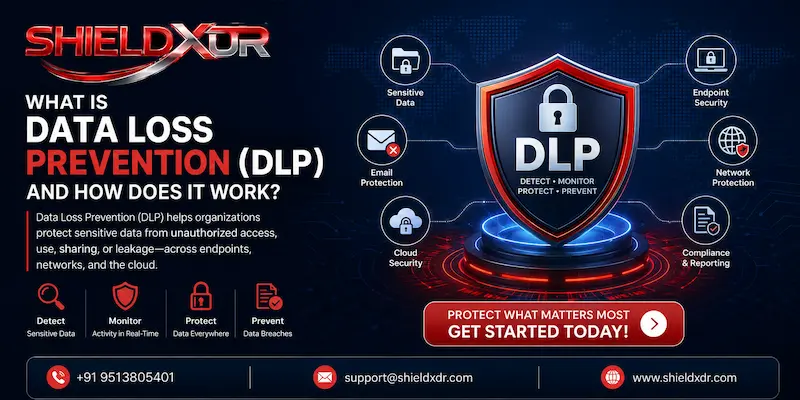
Do you know what Data Loss Prevention is, and how it can help organizations to protect themselves against unknown cyberthreats? If not, then you are at the right place. Here, we will talk about what DLP is and its related benefits in detail.
Moreover, we will introduce you to a reliable threat detection tool offered by a reputable VAPT service provider. What are we waiting for? Let’s get straight to the topic!
What Is Data Loss Prevention (DLP)?
Data Loss Prevention (DLP) is a cybersecurity approach that uses business policies and software tools to track, identify, and prevent the theft or leakage of confidential company information.
DLP systems automatically enforce security rules across endpoints, networks, and cloud environments to stop unauthorized users from copying, sharing, or uploading vital data, such as client records or intellectual property.
In the end, it acts as a vital layer of defense to prevent ransomware criminals from stealing internal files for schemes, including double extortion. Let’s take a look at what Data Loss Prevention is and how it benefits organizations in the IT Industry!
Why Data Loss Prevention Matters?
|
S.No. |
Factors |
Why? |
|
1. |
Mitigating Double-Extortion Ransomware |
Prevents hackers from obtaining private information to use as leverage for extortion before encrypting it. |
|
2. |
Ensuring Regulatory Compliance |
Automates data protection to prevent significant regulatory fines and comply with legal requirements (such as GDPR or HIPAA). |
|
3. |
Securing Intellectual Property |
Stops competitors from obtaining trade secrets, proprietary code, and original product designs. |
|
4. |
Preventing Insider Threats |
Prevents negligent or malevolent workers from sending, downloading, or sharing private information without authorization. |
|
5. |
Maintaining Total Data Visibility |
Keeps track of the precise locations of sensitive data throughout your network so you can determine what needs to be protected. |
Benefits of Implementing DLP
The following are the different benefits of implementing DLP:
1. Neutralizes Double-Extortion Blackmail: Deprives hackers of their main ransom leverage by preventing the outbound exfiltration of important files.
2. Automates Data Discovery and Mapping: Sensitive data is continuously scanned and logged throughout the network without the need for human auditing.
3. Enforces Continuous Regulatory Compliance: Instantly complies with stringent privacy regulations like GDPR and HIPAA by tracking data transfer in real time.
4. Eliminates Human Error and Carelessness: Instantly catches unintentional errors, such as staff members sending private spreadsheets to the incorrect external locations.
5. Shrinks the Network Access Surface: Eliminates needless internal exposure pathways and rigorously limits data access to authorized users.
Understanding Data States: Data in Motion, in Use, and at Rest
Comprehending data states entails protecting digital assets throughout their three separate stages: data in use is active information loaded into system memory and being processed by users or applications; data at rest is inactive information safely stored on hard drives or servers; and data in motion is information presently traveling across networks or the internet.
Cybersecurity tools, such as Data Loss Prevention systems, can apply the appropriate encryption and access controls depending on how the data is being handled when these states are correctly identified.
Key Components of a DLP System
|
S.No. |
Components |
What? |
|
1. |
Data Classification Engine |
Automatically classifies and tags files according to their level of sensitivity, including credit card or social security data. |
|
2. |
Discovery and Mapping Tools |
Finds and logs crucial information that has been concealed or forgotten by continuously scanning the whole network architecture. |
|
3. |
Policy Management Console |
Enables administrators to establish, implement, and amend data protection regulations via a single management dashboard. |
|
4. |
Endpoint Agents |
Employee devices are equipped with software that keeps an eye on and prevents unlawful copying, printing, or USB transfers of private documents. |
|
5. |
Network and Cloud Gateways |
Keeps an eye on cloud, email, and web traffic in order to intercept and prevent unwanted data from exiting the company's perimeter. |
Types of Data Loss Prevention Solutions
The following are the different types of Data Loss Prevention solutions:
● Endpoint DLP: Prevents unwanted USB transfers, printing, and copying by directly monitoring and controlling data access on user devices, such as laptops and servers.
● Network DLP: Checks and filters FTP, email, and web traffic at the perimeter to prevent private information from escaping the company network.
● Cloud DLP: Audits sharing permissions and prevents illegal file uploads and downloads to safeguard data kept in SaaS and IaaS systems.
● Discovery DLP: Finds, maps, and categorizes crucial files that are hidden or forgotten by continuously scanning databases, file servers, and cloud repositories.
How DLP Works: Core Mechanisms
DLP works in the following ways:
a) Content Identification & Classification: Identifies and tags sensitive information in files using digital fingerprints, regex, or keywords.
b) Contextual Analysis: Evaluates data according to external variables such as the transfer time, the target application, and the user's role.
c) Real-Time Traffic Inspection: Immediately detects illicit transfers by keeping an eye on network streams, email bodies, and endpoint activity.
d) Automated Policy Enforcement: When a security rule is broken, it immediately initiates defensive measures like blocking, encrypting, or alerting.
e) Incident Logging & Reporting: Helps security teams look into breaches and demonstrate compliance by creating a thorough audit trail of the incident.
Common Use Cases for DLP
|
S.No. |
Cases |
What? |
|
1. |
Blocking Ransomware Extortion |
Detects and stops large-scale, illegal file uploads to dubious cloud storage services or the dark web. |
|
2. |
Preventing Accidental Leaks |
Prevents well-intentioned staff members from inadvertently sending private spreadsheets or client information to external addresses via email. |
|
3. |
Securing Cloud Collaboration |
Keeps an eye on websites like Google Drive, Teams, and Slack to stop users from disclosing private company information to the public. |
Choosing the Right DLP Solution
In the following ways, you can choose the right DLP solution:
1. Accuracy of the Inspection Engine: To guarantee high detection rates with few disruptive false alarms, look for sophisticated contextual analysis.
2. Infrastructure and Deployment Scope: Make that the tool covers all required on-premise networks, endpoints, and cloud storage by matching it to your environment.
3. Ease of Policy Integration and Automation: Select systems that make it simple to create, implement, and automate rules without the need for intricate custom coding.
4. Performance Impact on Endpoints: Choose lightweight software agents that keep an eye on local device activity without consuming a lot of system RAM or impeding user productivity.
5. Native Security Ecosystem Integration: To coordinate a cohesive defense, make sure the solution connects straight to your current email gateways, SIEM, and EDR.
Best Practices for DLP Implementation
The following are the best practices for DLP implementation:
● Start with a Clear Data Inventory: Before blocking anything, map and categorize the data so you are aware of what you are safeguarding.
● Roll Out Controls in Phases: To prevent disrupting workflows, start with monitoring and progressively turn on strict blocking.
● Keep Policies Tight and Specific: To reduce disruptive false alarms, focus on particular data types rather than general guidelines.
● Incorporate Real-Time User Justification: During flagged acts, use interactive pop-ups to inform staff members about security policies.
● Define Clear Response Playbooks: When a significant data leak is discovered, establish quick, automated triage procedures for analysts.
Challenges and Limitations of DLP
|
S.No. |
Factors |
What? |
|
1. |
High Volumes of False Positives |
Misinterprets benign data transfers for security breaches, incorrectly blocking legal company operations. |
|
2. |
The Blindspot of Data Encryption |
Fails to examine the content of user-encrypted files or network streams. |
|
3. |
Massive Maintenance and Rule-Tuning Overhead |
To stay up with changing corporate data types, classification patterns must be manually updated on a regular basis. |
|
4. |
Limited Visibility into Unmanaged Devices |
Cannot keep an eye on or enforce security measures on unapproved shadow IT apps, smartphones, or personal PCs. |
|
5. |
The Complexity of Contextual Understanding |
Frequently treats a genuine developer's code transfer as a data leak and struggles to appropriately ascertain user intent. |
The Future of DLP: AI and Cloud Data Security
In order to replace strict, signature-based restrictions with flexible, context-aware security, DLP's future depends on AI-driven behavioral analytics and integrated cloud posture management. This change enables next-generation security systems to precisely determine user intent, dynamically isolate new threats in real time, and autonomously track data across disjointed SaaS ecosystems.
Conclusion
Now that we have talked about what Data Loss Prevention is, you might want to get your hands on a dedicated security tool to protect yourself from future unknown threats. For that, you can go for ShieldXDR, a dedicated threat detection and response tool offered by Craw Security.
ShieldXDR can automatically detect unknown threats and respond to them without any human intervention. Thus, you will be able to feel secure working in a protected environment. What are you waiting for? Contact, Now!
Frequently Asked Questions
About Data Loss Prevention
1. What is Data Loss Prevention (DLP)?
Data Loss Prevention (DLP) is a security tactic that uses software to keep an eye on, identify, and prevent critical company data from being stolen, leaked, or shared without authorization.
2. Why is DLP important for businesses?
DLP is important for businesses for the following reasons:
a) Stops Double-Extortion Ransomware,
b) Guarantees Regulatory Compliance,
c) Safeguards Intellectual Property,
d) Neutralizes Insider Threats, and
e) Provides Complete Data Visibility.
3. What are the different types of DLP solutions?
The following are the different types of DLP solutions:
a) Endpoint DLP,
b) Network DLP,
c) Cloud DLP, and
d) Discovery DLP.
4. How does DLP detect sensitive data?
DLP detects sensitive data in the following ways:
a) Rule-Based & Regular Expressions (Regex),
b) Database Fingerprinting (Exact Data Matching),
c) Document Fingerprinting (Partial or Full),
d) Conceptual & Lexical Analysis, and
e) Vector Machine Learning & Behavioral Analytics.
5. What is the difference between Network DLP and Endpoint DLP?
While Endpoint DLP keeps an eye on and regulates data activities directly on local user devices (such as preventing files from being printed or copied to a USB drive), Network DLP examines and prevents data transfers traveling outside the corporate network perimeter (such as emails or web uploads).
6. Can DLP prevent insider threats?
Yes, insider threats are prevented by DLP through constant user behavior monitoring and real-time denial of unlawful behaviors such as downloading large customer lists or transferring source code to personal cloud storage.
7. Which industries need DLP the most?
The following industries need DLP the most:
a) Healthcare,
b) Finance & Banking,
c) Technology & Software,
d) Defense & Aerospace, and
e) Legal & Professional Services.
8. How does DLP help with regulatory compliance?
DLP helps with regulatory compliance in the following ways:
a) Automated Data Discovery,
b) Enforces Industry Standards,
c) Restricts Unauthorized Sharing,
d) Maintains Continuous Auditing, and
e) Speeds Up Incident Response.
9. What are the common challenges in implementing DLP?
The following are some common challenges in implementing DLP:
a) Overwhelming Alert Fatigue,
b) Complex Data Classification,
c) Disruption to Business Workflows,
d) Massive Operational Maintenance, and
e) Blindspots from Encrypted Data and Shadow IT.
10. How do I choose the right DLP solution for my organization?
You should choose the right DLP solution for your organization by considering the following factors:
a) Map Your Data Ecosystem,
b) Assess the Accuracy Engine,
c) Check the Performance Footprint,
d) Verify Native Integrations, and
e) Evaluate Administrative Overhead.
Daksh
Cybersecurity expert and contributor at ShieldXDR, dedicated to sharing insights on threat detection, response, and overall digital security posture.