What Is the Difference Between Data Loss Prevention and Data Leak Prevention?
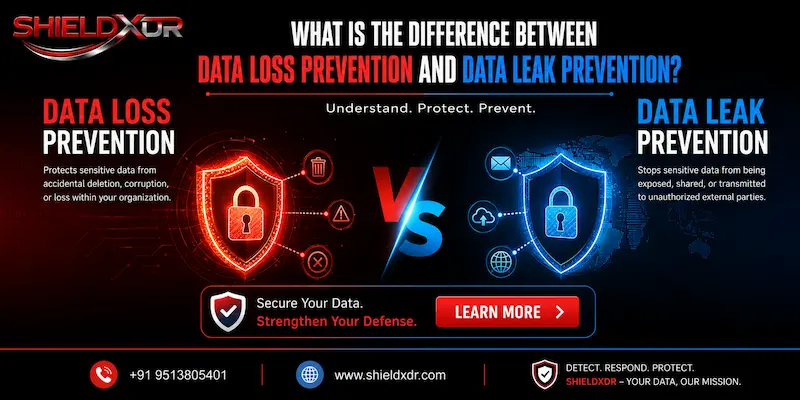
Do you want to learn about what are the differences between Data Loss Prevention and Data Leak Prevention and how they can help organizations against data losses? If yes, then you are at the right place. Here, we will talk about both and related features in detail.
Moreover, we will introduce you to a reliable XDR solution to prevent data loss offered by a reputable VAPT service provider. What are we waiting for? Let’s get straight to the topic!
What Is Data Loss Prevention (DLP)?
A collection of security procedures and techniques known as "Data Loss Prevention" (DLP) is intended to prevent sensitive data from being misplaced, misused, or accessed by unauthorized individuals.
DLP stops compliance violations and data exfiltration across an organization's endpoints, networks, and cloud environments by tracking, identifying, and blocking sensitive information, including PII, IP, and financial records in motion, at rest, or in use.
Let’s take a look at the difference between Data Loss Prevention and Data Leak Prevention to understand their benefits for organizations!
What Is Data Leak Prevention?
A targeted cybersecurity technique called "data leak prevention" aims to stop critical internal data from being unintentionally or unlawfully exposed to external environments. It intercepts data before it can leave the corporate border by continuously monitoring egress channels such as cloud storage, web uploads, and email transfers.
Data Loss Prevention vs. Data Leak Prevention: Key Differences Explained
|
S.No. |
Topics |
Factors |
What? |
|
1. |
Data Loss Prevention |
Primary Objective |
Ensures data availability and business continuity by preventing sensitive data from being mistakenly erased, altered, encrypted, or destroyed. |
|
Scope of Protection |
Focuses on protecting databases, storage, and internal systems from insider attacks and system failures. |
||
|
2. |
Data Leak Prevention |
Primary Objective |
Keeps private information from being exposed beyond the company's secure perimeter or from unlawfully escaping. |
|
Scope of Protection |
Primarily concentrates on keeping an eye on outgoing communication channels, such as web transfers, cloud uploads, and email, in order to prevent unwanted external transmission. |
Key Use Cases for Data Loss vs. Data Leakage
The following are the key use cases for data loss vs data leakage:
1. Data Loss Use Cases
a) Accidental Employee Deletion: Employing stringent access controls and automatic backup procedures to stop users from permanently deleting important files, databases, or shared cloud folders.
b) Ransomware & Malware Destruction: Preventing sensitive internal assets from being wiped or mass encrypted without authorization across network drives and terminals to maintain business continuity.
2. Data Leakage Use Cases
a) Insider Exfiltration via Outbound Channels: Preventing unhappy or compromised workers from downloading client databases, financial records, or IP to personal email, USB drives, or cloud storage.
b) Accidental Exposure in External Communications: Automatically identifying and preventing the unintentional emailing or public uploading of sensitive information (such as credit card numbers, SSNs, or private documents).
Common Causes of Data Loss and Data Leaks
The following are some common causes of data loss and data leaks:
● Human Error & Accidental Misconfiguration: Sensitive files are exposed to the public due to misplaced permissions or improperly set up cloud storage.
● Insider Threats: Workers steal private information through unapproved methods with malice or negligence.
● Ransomware & Malware Attacks: Critical records are encrypted, erased, or stolen by malicious software for extortion.
● Insecure Outbound Channels & Unencrypted Data Transfer: Attackers can intercept cleartext data from unprotected emails or uploads.
● Hardware Failure & Infrastructure Corruption: Local database assets are irreversibly destroyed by damaged disks or system crashes.
How Does Data Loss Prevention Work to Protect Sensitive Data?
|
S.No. |
Factors |
How? |
|
1. |
Data Discovery & Classification |
Finds the locations of important data on the network by scanning and classifying files according to sensitivity levels. |
|
2. |
Policy Enforcement & Rule Monitoring |
Uses automated security rules to monitor data consumption and access in cloud, storage, and endpoint settings. |
|
3. |
Contextual & Content Inspection |
Detects unusual activity in real time by analyzing both the file contents and the context of user actions. |
|
4. |
Automated Incident Response |
Revoke access to prevent breaches, quarantine high-risk assets, or immediately stop unauthorized file transfers. |
|
5. |
Continuous Visibility & Audit Reporting |
Keeps track of every data activity to ensure industry compliance and offer comprehensive security insights. |
How Does Data Leak Prevention Help Prevent Unauthorized Data Exposure?
Data leak prevention helps prevent unauthorized data exposure in the following ways:
a) Continuous Outbound Channel Monitoring: Monitors all outgoing email, cloud, and internet traffic to identify any unwanted data transfers.
b) Real-Time Data Fingerprinting & Inspection: Quickly identifies confidential records by comparing outgoing information to the distinct digital signatures of sensitive files.
c) Automated Perimeter Blocking: Prevents unauthorized file uploads and external email attachments from passing beyond the corporate network border.
d) Contextual Access Controls: Limits the exchange of sensitive data according to user responsibilities, device security, and location.
e) Encryption Enforcement: Sensitive files attached to outgoing conversations are automatically encrypted before being permitted to exit the protected area.
Benefits of Implementing Data Loss Prevention and Data Leak Prevention
The following are the benefits of implementing data loss prevention and data leak prevention:
1. Comprehensive Data Protection Across States: Protects important assets concurrently whether they are being used, transferred across networks, or kept at rest.
2. Streamlined Regulatory Compliance: Automates controls to satisfy stringent regulations for frameworks such as PCI-DSS, GDPR, and HIPAA.
3. Ransomware & Extortion Mitigation: Stops hackers from erasing important databases or stealing private information for double-extortion schemes.
4. Intellectual Property & Brand Preservation: Prevents trade secrets, customer data, and proprietary source code from leaking and harming a company's reputation.
5. Enhanced Visibility into Data Workflows: Enables real-time monitoring of the movement of sensitive data across endpoints, cloud apps, and user actions.
Best Practices for Preventing Data Loss and Data Leaks
|
S.No. |
Practices |
What? |
|
1. |
Implement Comprehensive Data Discovery & Classification |
Sensitive files should be automatically identified and labeled to guarantee that the proper security measures are consistently implemented. |
|
2. |
Enforce Strict Least-Privilege Access Controls |
Restrict employee access permissions to the precise information required for each job role. |
|
3. |
Maintain Automated, Immutable Backups |
To prevent erasure or ransomware encryption, regularly back up important data to write-once, read-many (WORM) storage. |
|
4. |
Monitor and Control All Outbound Communication Channels |
To stop illegal external transfers, audit and limit USB drives, email attachments, and web uploads. |
|
5. |
Conduct Regular Security Awareness & Phishing Training |
To reduce human error, train employees on data handling procedures and social engineering warning signs. |
DLP Strategy: How to Combine Both Solutions for Complete Coverage?
You can combine both solutions for complete coverage in the following ways:
● Unified Data Classification Framework: Label all assets consistently so that the sensitivity policies for leak protection and loss prevention instruments are the same.
● Integrated Endpoint & Perimeter Controls: Combine network gateway inspection to prevent unwanted external transfers with local endpoint monitoring to prevent file deletion.
● Cross-Telemetry SIEM Integration: To link internal misuse with egress anomalies in real time, centralize the logs from both systems into a single dashboard.
● Layered Backup & Exfiltration Protection: Combine automated egress blocking to avoid public exposure with immutable offshore backups to restore deleted data.
● Continuous Policy Tuning & Incident Automation: To automatically mitigate threats without interfering with lawful operations, refine rules on a regular basis using shared threat knowledge.
Future Trends in Data Loss Prevention and Data Leak Prevention
The following are the future trends in data loss prevention and data leak prevention:
a) Integration of Data Security Posture Management (DSPM): Uses active DLP policies and automatically finds cloud data to close visibility gaps.
b) AI-Driven Contextual Analytics Over Static Blocking: Uses machine learning rather than strict string constraints to assess file context and user intent.
c) Generative AI Guardrails & Prompt Governance: Checks data entering LLMs and AI models to avoid sensitive quick exposure.
d) Predictive Risk Forecasting & Behavioral Prevention: Monitors abnormalities in user and entity behavior to stop exfiltration efforts before they happen.
e) Zero Trust Data-Centric Convergence: Regardless of the user's device or location, continuous, adaptive access policies are applied directly to data assets.
Conclusion: Which Is More Important, Data Loss Prevention or Data Leak Prevention?
Now that we have talked about what is the difference between Data Loss Prevention and Data Leak Prevention, you might want to get a dedicated cybersecurity solution to reduce data loss. For that, you can go for ShieldXDR, a dedicated threat detection and response tool offered by Craw Security.
ShieldXDR can help organizations to automatically detect cybersecurity threats and malicious risks and deal with them with ease without human intervention. What are you waiting for? Contact, Now!
Frequently Asked Questions
About Data Loss Prevention and Data Leak Prevention
1. What is the difference between Data Loss Prevention (DLP) and Data Leak Prevention?
While Data Leak Prevention prevents sensitive files from being disclosed or communicated outside the company, Data Loss Prevention (DLP) prevents sensitive files from being permanently destroyed or corrupted internally.
2. Is Data Leak Prevention the same as Data Loss Prevention?
No, data leak prevention stops sensitive data from being unlawfully exposed or transmitted to external environments, but data loss prevention stops sensitive data from being destroyed, corrupted, or lost within.
3. Why is Data Loss Prevention important for businesses?
Data loss prevention important for businesses for the following reasons:
a) Protects Sensitive Data & Intellectual Property,
b) Ensures Regulatory Compliance,
c) Mitigates Cyber Threats & Ransomware,
d) Maintains Business Continuity, and
e) Saves Costs & Preserves Brand Reputation.
4. What are the common causes of data leaks?
The following are the common causes of data leaks:
a) Misconfigured Cloud Storage & Databases,
b) Malicious Insider Threats,
c) Social Engineering & Phishing Attacks,
d) Insecure External File Sharing, and
e) Unpatched Software & Zero-Day Vulnerabilities.
5. How does a Data Loss Prevention solution work?
A Data Loss Prevention solution works in the following ways:
a) Discovers and Classifies Data,
b) Monitors Data Across States,
c) Inspects Content and Context,
d) Enforces Security Policies, and
e) Responds and Reports Automatically.
6. Can Data Loss Prevention prevent insider threats?
Yes, by continuously monitoring user activity to automatically prevent unlawful copying, downloading, sharing, or deletion of sensitive data, DLP helps avoid insider threats.
7. Which industries benefit the most from Data Loss Prevention?
The following industries benefit the most from data loss prevention:
a) Healthcare & Life Sciences,
b) Financial Services & Banking,
c) Government & Defense,
d) Technology & Software Development, and
e) Retail & E-Commerce.
8. What features should you look for in a Data Loss Prevention solution?
You should look for the following features in a data loss prevention solution:
a) Automated Discovery & Content Classification,
b) Multi-State Data Protection (Rest, Motion, Use),
c) Granular Policy & Context-Aware Controls,
d) Automated Incident Response & Remediation, and
e) Centralized Management & Compliance Reporting.
9. How can organizations reduce the risk of data leaks?
Organizations can reduce the risk of data leaks in the following ways:
a) Implement Continuous Data Discovery & Classification,
b) Enforce Strict Zero Trust & Least-Privilege Access,
c) Monitor and Control All Outbound Channels,
d) Mandate Robust Encryption Across Data States, and
e) Conduct Ongoing Security Awareness & Phishing Training.
10. What are the best practices for implementing a Data Loss Prevention strategy?
The following are the best practices for implementing a data loss prevention strategy:
a) Define Objectives & Prioritize Critical Data,
b) Establish Clear Governance & Data Handling Policies,
c) Adopt a Phased Deployment Approach,
d) Involve Stakeholders Across Departments, and
e) Continuously Audit, Educate, & Refine.
Daksh
Cybersecurity expert and contributor at ShieldXDR, dedicated to sharing insights on threat detection, response, and overall digital security posture.