What Is Email DLP and How Does It Stop Data Leaks?
Do you know how Email DLP works and how it can boost the security measures of organizations? If not, then you are at the right place. Here, we will talk about what email DLP is and related facilities in detail.
Moreover, we will introduce you to a reliable cybersecurity solution offered by a reputable VAPT service provider. What are we waiting for? Let’s get started!
What Is Email DLP (Email Data Loss Prevention)?
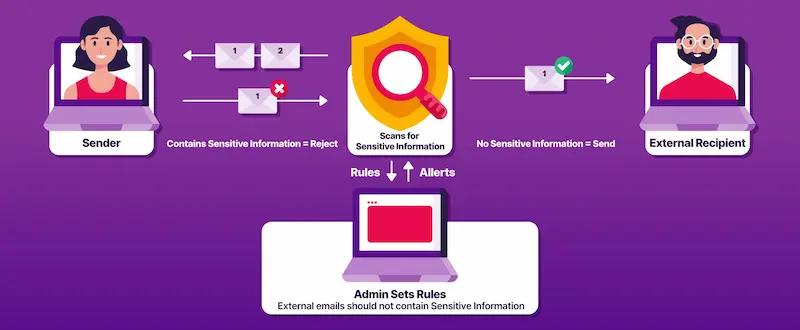
Email Data Loss Prevention (Email DLP) is a cybersecurity measure that examines outgoing emails and their attachments to identify and prevent the unauthorized transfer of sensitive information, including financial data or intellectual property.
It automatically encrypts, quarantines, or blocks messages that breach compliance regulations or company safety standards by enforcing predefined security policies. Ultimately, Email DLP serves as a digital protection mechanism to avert data breaches, human mistakes, and inadvertent leaks before data exits the corporate network.
Let’s take a look at what Email DLP is, its uses, its features, and its benefits for users working in the IT Industry!
Why Is Email Security Critical for Modern Businesses?
Email security is critical for modern businesses for the following reasons:
1. Primary Target for Cyberattacks: Phishing and malware attacks often exploit email as the primary method for hackers to infiltrate corporate networks.
2. Protection Against Financial Loss: Robust email security stops expensive business email compromise (BEC) scams, ransom payments, and operational downtime.
3. Safeguarding Sensitive Data: It guarantees that proprietary intellectual property, trade secrets, and internal communications remain secure from leaks or theft.
4. Regulatory and Legal Compliance: To meet stringent legal requirements such as GDPR and HIPAA and to avert substantial penalties for non-compliance, companies must ensure the security of email data.
5. Maintaining Trust and Reputation: Preventing email breaches safeguards a company’s brand reputation and assures clients of their safety in dealings with it.
Common Causes of Email Data Leaks
The following are the common causes of email data leaks:
● Human Error and Accidental Misdelivery: Accidentally dispatching confidential data to the incorrect recipient.
● Phishing and Social Engineering: Scammers deceive employees into providing them with credentials or data.
● Malicious Insider Threats: Employees who are dissatisfied with their jobs and who are deliberately stealing or leaking confidential company information.
● Lack of Encryption and Poor Controls: Sending emails in plaintext without protection, which hackers can easily intercept.
● Shadow IT and Unapproved Third-Party Tools: Employees sharing work files via personal email accounts or apps that are not sanctioned.
Types of Sensitive Data That Email DLP Protects
|
S.No. |
Types |
What? |
|
1. |
Personally Identifiable Information (PII) |
Social Security numbers, driver's licenses, passports, and home addresses that may identify specific employees or customers. |
|
2. |
Financial Data (PCI-DSS) |
Bank account details, credit card numbers, routing numbers, and financial statements. |
|
3. |
Protected Health Information (PHI) |
Patient records, health insurance information, and medical histories are governed by healthcare compliance laws. |
|
4. |
Intellectual Property (IP) |
Source code, product designs, confidential business information, patents, and forthcoming research and development data. |
|
5. |
Corporate Credentials and Infrastructure Data |
Passwords for the workplace, server setups, API keys, and specifics of internal system architecture. |
Regulatory Compliance and Data Privacy Standards
The following are the regulatory compliance and data privacy standards:
a) GDPR: Safeguards the data privacy rights of EU citizens through rigorous worldwide enforcement.
b) HIPAA: Safeguards ensure the protection of health information and patient data within the healthcare sector.
c) PCI-DSS: Protects payment processing systems and credit card data from fraudulent activities.
d) CCPA / CPRA: Gives California consumers authority over the collection and use of their personal data by businesses.
e) PIPEDA: Regulates the management of personal data by private-sector organizations in Canada as they engage in commercial activities.
Key Components of an Email DLP Solution
The following are the key components of an Email DLP solution:
1. Content Inspection and Deep Analysis: Examines email content, metadata, and attachments (even compressed files) to detect sensitive keywords and patterns.
2. Policy Engine and Pre-built Templates: Make use of customizable rules and regulatory templates (such as HIPAA or GDPR) to automatically identify compliance violations.
3. Contextual and Behavioral Analysis: Assesses the sender, recipient, timing, and historical data patterns to identify anomalies that conventional text matching overlooks.
4. Automated Remediation Actions: Carry out immediate actions such as blocking, quarantining, encrypting, or notifying administrators upon policy activation.
5. Incident Reporting and Analytics: Offers centralized dashboards and audit logs for tracking data leak trends and showing compliance to auditors.
How does Email DLP Detect Sensitive Information?
|
S.No. |
Factors |
How? |
|
1. |
Regular Expression (Regex) & Pattern Matching |
Recognizes organized data such as credit card numbers or SSNs through particular alphanumeric patterns. |
|
2. |
Keyword and Dictionary Lists |
Checks text against established databases of sensitive expressions, including "confidential" and "internal use only." |
|
3. |
Data Fingerprinting (Exact Data Matching) |
Compares email content with exact hashes of database records to avert targeted database leaks. |
|
4. |
Exact File Matching |
Monitors and prevents the transfer of identical copies of certain sensitive documents that have not been authorized. |
|
5. |
Optical Character Recognition (OCR) |
Extracts and examines text embedded in scanned images, screenshots, and PDFs that are attached to emails. |
Email DLP Policies and Rule-Based Protection
Email DLP policies consist of the particular regulations and structures established by administrators to manage the handling of sensitive information in outgoing communications. When an email activates a rule like having a credit card number or a sensitive keyword, the policy engine automatically implements a predefined action, such as encrypting, quarantining, or completely blocking the message.
AI-Powered Email DLP: Smarter Threat Detection
By utilizing machine learning and natural language processing to comprehend the context and intent of communications, Email DLP powered by AI improves upon conventional detection methods.
This enables it to precisely identify advanced threats such as behavioral anomalies and social engineering, all the while significantly lowering the occurrence of false positives.
Email DLP vs Traditional Email Security Solutions
|
S.No. |
Topics |
Factors |
What? |
|
1. |
Traditional Email Security Solutions |
Focuses on Inbound Threats |
It is mainly intended to prevent external dangers from accessing the network, including spam, malware, ransomware, and phishing emails. |
|
Lacks Deep Content Context |
Examines incoming traffic for recognized harmful links or attachments, yet does not actively monitor the sensitive nature of outgoing data. |
||
|
2. |
Email DLP (Data Loss Prevention) |
Focuses on Outbound Data Protection |
Specifically oversees and regulates outgoing emails and attachments to prevent sensitive data from exiting the organization. |
|
Enforces Compliance and Policies |
Utilizes advanced examination methods (such as data fingerprinting and OCR) to prevent, encrypt, or isolate emails that breach stringent regulatory requirements or corporate safety protocols. |
Benefits of Implementing Email DLP for Organizations
The following are the benefits of implementing email DLP for organizations:
● Prevents Costly Data Breaches: Prevents sensitive data from exiting the network, thereby protecting organizations from costly remediation expenses and legal repercussions.
● Ensures Regulatory Compliance: Automatically ensures that email practices are in line with global frameworks such as GDPR, HIPAA, and PCI-DSS to prevent fines for non-compliance.
● Protects Brand Reputation and Trust: Maintains the trust of customers and partners by guaranteeing that their private information is never revealed through email leaks.
● Educates Employees in Real Time: Instigates immediate policy alerts that instruct employees on safe data-handling practices as they carry out their work tasks.
● Provides Complete Visibility and Auditing: Provides detailed logs and tracking of outbound data movement, facilitating the generation of reports for security audits.
Best Practices for Implementing an Effective Email DLP Strategy
The following are the best practices for implementing an effective email DLP strategy:
a) Discover and Classify Your Data First: Before drafting policies, ascertain the existence of sensitive data, its locations, and what requires safeguarding.
b) Start with a Crawl-Walk-Run Approach: Start with monitoring-only mode to watch data flows, then gradually implement strict blocking rules.
c) Optimize Policies to Reduce False Positives: Utilize context and machine learning to fine-tune detection rules, ensuring that legitimate business workflows are not disrupted.
d) Implement Real-Time Employee Feedback: Employ automated pop-up notifications to inform users about data safety at the exact moment a policy is activated.
e) Continuously Audit and Update Rules: Periodically examine incident logs and adjust DLP rules to align with new business processes and changing regulations.
Why Should Businesses Combine Email DLP with XDR and SIEM?
|
S.No. |
Factors |
Why? |
|
1. |
Unified Security Context and Correlation |
Connect email data with network and endpoint telemetry to reveal intricate attack paths. |
|
2. |
Accelerated Incident Response |
Automates the containment process by immediately activating XDR isolation rules upon leak detection. |
|
3. |
Elimination of Security Silos |
Consolidates separate email notifications into a unified security dashboard for comprehensive visibility. |
|
4. |
Advanced Insider Threat Detection |
Merges email activity with SIEM logs to identify unusual data exfiltration patterns. |
|
5. |
Streamlined Compliance and Auditing |
Brings together all email and system logs into a single location to simplify regulatory reporting. |
How does ShieldXDR Enhance Email DLP and Data Leak Prevention?
ShieldXDR enhances email DLP and DLP in the following ways:
1. Native AI-Driven Data Discovery: Automatically identifies, categorizes, and scans content for PII or source code across emails, databases, and cloud applications.
2. Content-Aware Multi-Channel Blocking: Prevents unauthorized data transfers immediately across emails, web uploads, clipboards, screenshots, and USB devices.
3. Unified XDR Telemetry Correlation: Cross-references email activity with endpoint and network logs to eliminate blind spots and trace intricate leak paths.
4. Intelligent User Behavior Analytics (UBA): Utilizes behavioral profiling to identify unusual data transfers and reduce threats from potential insider attacks.
5. Automated Rapid Incident Response: Utilizes automated playbooks to isolate compromises, revoke active sessions, and contain data leaks in under five minutes.
Conclusion
Now that we have talked about what Email DLP is, you might want to get your hands on a dedicated security solution against threats like email DLP. For that, you can go for ShieldXDR, a dedicated threat detection and response tool offered by Craw Security.
ShieldXDR can help organizations to automatically detect cyber threats & suspicious activities and deal with them with ease. Thus, you can feel safer while working in your work environment. What are you waiting for? Contact, Now!
Frequently Asked Questions
About Email DLP
1. What is Email DLP, and why is it important?
Email Data Loss Prevention (Email DLP) is an essential cybersecurity measure that examines outgoing emails to identify and prevent the unauthorized transfer of sensitive information, thereby averting expensive breaches and maintaining adherence to regulations.
2. How does Email DLP prevent sensitive data leaks?
Email DP prevents sensitive data leaks in the following ways:
a) Deep Content Inspection,
b) Contextual Policy Enforcement,
c) Automated Remediation Actions,
d) Advanced Detection Techniques, and
e) Real-Time User Prompts.
3. What types of data can Email DLP detect and protect?
The following types of data email DLP can detect and protect:
a) Personally Identifiable Information (PII),
b) Financial and Payment Data,
c) Protected Health Information (PHI),
d) Intellectual Property (IP), and
e) Corporate Credentials and Access Keys.
4. What is the difference between Email DLP and traditional email security?
Whereas traditional email security is aimed at preventing incoming threats such as spam and phishing, Email DLP concentrates on examining and managing outgoing content to avert sensitive data leaks.
5. Can Email DLP stop accidental data leaks caused by employees?
Yes, Email DLP prevents accidental leaks by real-time scanning of outgoing messages to block, quarantine, or encrypt emails that are sent to incorrect recipients or that include unauthorized sensitive information.
6. How does AI improve Email DLP capabilities?
AI improves Email DLP capabilities in the following ways:
a) Contextual and Intent Analysis,
b) Reduces False Positives,
c) Detects Hidden and Visual Data,
d) Adaptive Behavioral Profiling, and
e) Automated Threat Classification.
7. Which industries benefit the most from Email DLP solutions?
The following industries benefit most from Email DLP solutions:
a) Healthcare and Pharmaceuticals,
b) Banking and Financial Services,
c) Legal and Professional Services,
d) Government and Defense, and
e) Technology and Manufacturing.
8. Does Email DLP help organizations meet compliance requirements?
Yes, Email DLP guarantees compliance by automatically overseeing and limiting outgoing data transfers to conform with regulations such as GDPR, HIPAA, and PCI-DSS.
9. How does Email DLP integrate with XDR and SIEM platforms?
By feeding alerts about outbound communication and activity logs into a centralized dashboard, Email DLP integrates with XDR and SIEM, enabling security teams to correlate email data with endpoint and network telemetry for a unified and automated incident response.
10. What should businesses consider when selecting an Email DLP solution?
Businesses should consider the following factors while selecting an Email DLP solution:
a) Accuracy and False Positive Rates,
b) Ease of Integration,
c) Granular Policy and Remediation Controls,
d) Regulatory Compliance Templates, and
e) User and Admin Experience.
Daksh
Cybersecurity expert and contributor at ShieldXDR, dedicated to sharing insights on threat detection, response, and overall digital security posture.