Best XDR Service in India for Business Cybersecurity
Do you know what an XDR Service is and how it can enhance your business’s chances of improved cybersecurity measures? If not, then you are at the right place. Here, we will talk about the XDR service and related benefits in detail.
Moreover, we will introduce you to a reliable XDR solution offered by a reputable VAPT service provider. What are we waiting for? Let’s get started!
What Is an XDR Service?
A comprehensive cybersecurity solution called Extended Detection and Response (XDR) compiles and correlates threat information from several security layers, such as emails, network servers, endpoints, and cloud workloads.
It uses sophisticated analytics and automation to dismantle conventional security silos and give security teams comprehensive visibility, quick threat detection, and coordinated incident response.
Let’s take a look at what XDR Service is, its uses, its features, and its benefits for organizations in the IT Industry!
Common Cyber Threats Detected by XDR
|
S.No. |
Factors |
What? |
|
1. |
Advanced Persistent Threats (APTs) |
Detect stealthy, ongoing cyber espionage efforts by correlating low-level irregularities across many network levels. |
|
2. |
Multi-Stage Ransomware Attacks |
Before ransomware can lock important data, it detects early-stage lateral movement and unauthorized encryption processes. |
|
3. |
Fileless and Living-off-the-Land (LotL) Malware |
Detects malevolent misuse of authorized, integrated administrative tools, such as PowerShell, to get around common antivirus software. |
|
4. |
Sophisticated Credential Theft and Identity Compromise |
Uses user behavior analytics to identify unusual login locations and credential stuffing. |
|
5. |
Cloud Misconfigurations and Data Exfiltration |
Identify abnormal outbound transfers between cloud workloads and storage buckets, as well as unlawful data staging. |
How does XDR Strengthens Business Cybersecurity?
XDR strengthens business cybersecurity in the following ways:
1. Eliminates Security Silos through Unified Visibility: Combines information from networks, cloud, and endpoints into a single control window.
2. Accelerates Threat Detection with Advanced AI Correlation: Connects distinct, low-level irregularities into recognized risks via machine learning.
3. Slashes Dwell Time via Automated Incident Response: Instantly initiates automated playbooks to neutralize active attacks and quarantine compromised hosts.
4. Drastically Reduces Alert Fatigue for IT Teams: Combines thousands of dispersed signals into a small number of significant, high-priority security situations.
5. Lowers Total Cost of Ownership (TCO) and Boosts Efficiency: Combines several disparate security measures into a single, incredibly effective platform.
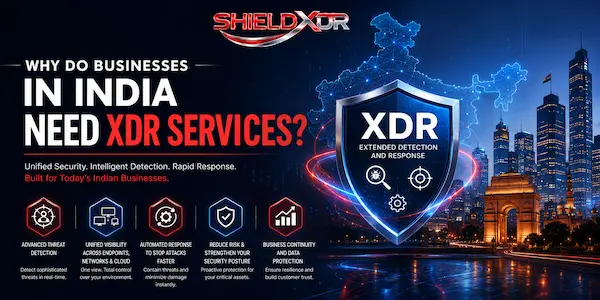
Why do businesses in India need XDR Services?
Businesses in India need XDR services for the following reasons:
● Hardening Defenses Against Escalating AI-Driven Ransomware: Uses automated, ongoing monitoring to quickly neutralize rapidly changing, AI-powered extortion threats.
● Strict Alignment with the DPDP Act and Compliance Mandates: Guarantees ongoing data visibility and logging to prevent harsh financial fines under India's privacy regulations.
● Neutralizing Severe Supply Chain Vulnerabilities: Keeps an eye on linked vendor ecosystems to prevent cross-company threats before they get into your network.
● Overcoming the Acute Cybersecurity Talent Shortage: Empowers lean IT teams without requiring dozens of skilled security analysts by using centralized AI correlation.
● Securing Rapid, Fragmented Hybrid Work Environments: Unifies visibility across dispersed mobile devices, cloud apps, and home networks outside of the conventional office boundaries.
Compliance and Regulatory Requirements for Indian Businesses
|
S.No. |
Factors |
What? |
|
1. |
Digital Personal Data Protection (DPDP) Act, 2023 |
Requires user rights, stringent consent for handling personal data, and severe punishments for data breaches. |
|
2. |
CERT-In Cyber Security Directions |
Requires keeping required log records and reporting significant cyber events within a fixed 6-hour deadline. |
|
3. |
RBI Cyber Security Framework |
Enforces regular vulnerability assessments, ongoing SOC monitoring, and baseline security rules for financial firms. |
|
4. |
SEBI Cybersecurity and Cyber Resilience Framework |
Requires market intermediaries to have thorough disaster recovery plans, regular penetration testing, and quarterly audits. |
|
5. |
Companies Act, 2013 (Section 134 & Rules) |
Requires directors of the company to formally attest to the effectiveness and sufficiency of internal data and financial controls. |
Industries That Need XDR Protection the Most
The following are some industries that need XDR protection the most:
a) Healthcare and Pharmaceuticals: Prevents targeted ransomware attacks on extremely sensitive patient health information and crucial medication development.
b) Banking, Financial Services, and Insurance (BFSI): Prevents sophisticated financial crime by locking down cloud infrastructure and securing large transactional data flows.
c) IT, Software, and Tech Services: Protect proprietary source code and stop downstream business clients from being compromised by supply chain vulnerabilities.
d) Manufacturing and Critical Infrastructure: Prevents catastrophic physical production shutdowns by combining operational and IT security levels.
e) E-Commerce and Retail: Protects high-volume databases and client payment interfaces from ongoing data theft and credential stuffing.
Challenges Businesses Face Without XDR
The following are some of the challenges faced by businesses without XDR:
1. Severe Blind Spots from Fragmented Security Silos: Leave enormous security holes because disparate tools are unable to exchange vital threat information.
2. High "Dwell Time" and Slow Incident Response: Because of the limits of manual tracking, intruders can remain undiscovered for months.
3. Intense Alert Fatigue for IT Teams: Every day, thousands of dispersed, unprioritized false positives overwhelm lean workers.
4. Vulnerability to Sophisticated, Multi-Vector Attacks: Fails to prevent sophisticated hacks that target the network, cloud, and email at the same time.
5. Increased Operational Costs and Inefficiencies: Require companies to license and maintain dozens of different security tools, which drains budgets.
Signs Your Business Needs an XDR Service
|
S.No. |
Signs |
What? |
|
1. |
Your Team is Drowning in Disconnected Alert Fatigue |
Hours are wasted by analysts pursuing thousands of disorganized false positives from several dashboards. |
|
2. |
Threat Investigations Take Days Instead of Minutes |
Critical breach discovery is delayed when connecting the dots manually across many platforms. |
|
3. |
Critical Gaps Exist Between Endpoint and Cloud Environments |
There are blind spots for lateral movement since security personnel do not have cross-layer visibility. |
|
4. |
You Rely Strictly on Manual Containment Tactics |
Because integrated playbooks do not immediately segregate threats, attacker dwell time increases. |
|
5. |
Compliance Audits and Cyber Insurance Renewals are Failing |
The company is unable to offer centralized logs or evidence of ongoing threat monitoring. |
Why Managed XDR Is Better Than Traditional Security Monitoring?
Managed XDR is better than traditional security monitoring for the following reasons:
● Shift from Passive Alerting to Active, Automated Containment: Rather than only sending passive warning signals, it immediately shuts down and isolates infected assets.
● Elimination of Security Tool Silos Through Centralized AI Correlation: Exposes hidden assaults by combining endpoint, network, and cloud data into a single, coherent chronology.
● Continuous 24/7/365 Human Oversight and Threat Hunting: Pairs automated tools with elite analysts who are available around-the-clock to aggressively search for vulnerabilities.
● Direct Eradication of Alert Fatigue: Aggregates thousands of dispersed warnings into a small number of verified instances after filtering out background noise.
● Drastically Reduced Total Cost of Ownership (TCO): Reduces capital costs by offering a team- and enterprise-grade security stack without the internal burden.
Key Features of the Best XDR Service in India
The following are the key features of the best XDR services in India:
a) Domestic Data Residency: The DPD Act and CERT-In regulations are satisfied because the data is kept in India.
b) Open XDR Architecture: It links to all of your current security products without requiring any changes.
c) Agentic AI Correlation: Its sophisticated technology creates a larger attack by combining small threats from various areas.
d) Autonomous Response: The system automatically disconnects the compromised device from the network as soon as it detects a threat.
e) 24/7 Managed Threat Hunting: In addition, a group of knowledgeable analysts monitors your network around-the-clock.
Benefits of Choosing a Managed XDR Service
|
S.No. |
Benefits |
How? |
|
1. |
24/7/365 Continuous Monitoring |
Ensures that assaults that take place late at night or on vacations are promptly identified and stopped by offering uninterrupted round-the-clock security. |
|
2. |
Proactive Threat Hunting |
Experts actively seek out and remove sophisticated, undetected dangers concealed deep within your network; they don't only wait for alerts. |
|
3. |
Immediate Automated Response |
When a danger is detected, the system immediately and automatically takes action, such as isolating an infected device to stop the assault from propagating throughout the network. |
|
4. |
Cost-Effective Enterprise Security |
Provides superior, enterprise-level security without the high costs associated with developing an internal Security Operations Center (SOC) or employing costly cybersecurity specialists. |
|
5. |
Drastic Reduction in Alert Fatigue |
By eliminating thousands of unnecessary and false alarms, the platform frees up your IT staff's important time to concentrate solely on genuine, serious threats. |
Best Practices for Successful XDR Implementation
The following are the best practices for successful XDR implementation:
1. Define Clear Integration Use Cases: Determine which network, cloud, and endpoint data sources must be fed into the XDR platform first.
2. Customize Response Playbooks: To guarantee prompt containment without interfering with essential business processes, create automated response steps for particular threats.
3. Align with Standard Frameworks: For thorough threat coverage, map your XDR detection algorithms directly to international standards like MITRE ATT&CK.
4. Train Your IT and Security Teams: Make sure your employees are capable of interpreting XDR insights and working together effectively in the event of a security incident.
5. Continuously Test with Simulations: Verify that your XDR technology generates the appropriate alerts by conducting frequent breach and attack simulations.
Future of XDR Services in India's Cybersecurity Landscape
The use of autonomous, agentic AI that can neutralize multi-vector attacks at machine speed before they reach critical infrastructure will be the driving force behind XDR services in India in the future.
XDR will transition from a luxury to a fundamental compliance and defensive requirement for Indian businesses facing an increasingly complex threat landscape as stringent digital privacy regulations tighten countrywide.
What is ShieldXDR?
Cloud, network, and endpoint security are all integrated into a single dashboard using ShieldXDR, a powerful Extended Detection and Response technology created by India-based Craw Security.
It offers automatic incident containment, ongoing threat hunting, and integrated Data Loss Prevention (DLP) to shield businesses against ransomware and zero-day attacks. It is powered by AI, machine learning, and behavioral analytics.
Benefits of ShieldXDR for Organizations
The following are the benefits of ShieldXDR for organizations:
● Unified Threat Visibility (All-in-One Dashboard): Removes blind areas by combining network, cloud, and endpoint logs into a single, unified view.
● AI-Powered Ransomware & Zero-Day Detection: Detects covert assaults that conventional antivirus software overlooks by using machine learning and behavioral analytics.
● Integrated Data Loss Prevention (DLP): Ensures tight compliance by preventing unwanted data exchange across cloud apps, USB devices, and clipboards.
● Sub-5-Minute Automated Incident Response: Uses intelligent playbooks to quickly terminate access sessions and isolate compromised hosts before harm is done.
● Built-in Dark Web & Proactive Monitoring: Searches dark web forums for compromised company information and credentials to stop breaches before they affect your network.
Conclusion
Now that we have talked about what XDR Service is, you might want to get your hands on a dedicated XDR solution from a reliable source. For that, you can go for ShieldXDR, a dedicated threat detection and response tool offered by Craw Security.
ShieldXDR can automatically detect unauthorized access or suspicious activities over your networks & systems and can deal with them with ease. What are you waiting for? Contact, Now!
Frequently Asked Questions
About XDR Service
1. What is XDR in cybersecurity?
A comprehensive cybersecurity solution called Extended Detection and Response (XDR) automatically gathers, correlates, and evaluates threat data from endpoints, networks, cloud workloads, and emails in order to provide a quick, automated response.
2. How does XDR help protect businesses from cyberattacks?
XDR can help protect businesses from cyberattacks in the following ways:
a) End-to-End Visibility,
b) Smart Threat Correlation,
c) Instant Automated Response,
d) Drastic Reduction in Alert Fatigue, and
e) Drastically Lowers Attack Dwell Time.
3. What are the main features of an XDR service?
The following are the main features of an XDR service:
a) Cross-Layer Data Collection,
b) AI-Driven Threat Correlation,
c) Automated Incident Response,
d) Centralized Detection and Response Dashboard, and
e) Proactive Threat Hunting.
4. How is XDR different from EDR and MDR?
While MDR is the round-the-clock human-managed service that runs these technologies for you, EDR mainly concentrates on endpoint devices; XDR broadens that protection by combining endpoints, networks, and cloud data into a single platform.
5. Can XDR detect ransomware attacks in real time?
Yes, XDR uses behavioral AI to quickly identify malicious file encryption and automatically isolate compromised devices before the malware can propagate. This allows XDR to detect ransomware in real time.
6. Is XDR suitable for small and medium-sized businesses?
Yes, XDR is a great fit for small and medium-sized enterprises, particularly when offered as a Managed XDR service that offers enterprise-grade security without requiring a costly internal cybersecurity team.
7. How does XDR improve incident response time?
XDR can improve incident response time in the following ways:
a) Unified Centralized Context,
b) Automated Root-Cause Analysis,
c) Machine-Speed Orchestration,
d) Elimination of Alert Fatigue, and
e) One-Click Remediation.
8. What should businesses look for when choosing an XDR service in India?
Businesses should look for the following things while choosing an XDR service in India:
a) Localized Data Residency & Regulatory Compliance,
b) Vendor-Agnostic "Open XDR" Architecture,
c) Agentic AI & High-Fidelity Correlation,
d) Automated, Sub-5-Minute Containment Playbooks, and
e) Hybrid 24/7 Threat Hunting Support (MDR Combo).
9. Can XDR integrate with existing security tools and cloud platforms?
Yes, Open XDR platforms are made especially to interface directly with your current security technologies, such as firewalls, EDR, IAM, and cloud platforms like AWS, Azure, and GCP, so you can unify your defense without having to do an expensive "rip-and-replace."
10. Why is managed XDR becoming popular among Indian businesses?
Because it enables companies to accomplish enterprise-grade threat defense around-the-clock and rigorous compliance with the DPDP Act and CERT-In standards without incurring the enormous costs associated with developing an internal security staff, managed XDR is becoming increasingly popular in India.
Daksh
Cybersecurity expert and contributor at ShieldXDR, dedicated to sharing insights on threat detection, response, and overall digital security posture.