What Is Vulnerability Assessment and Penetration Testing (VAPT)?
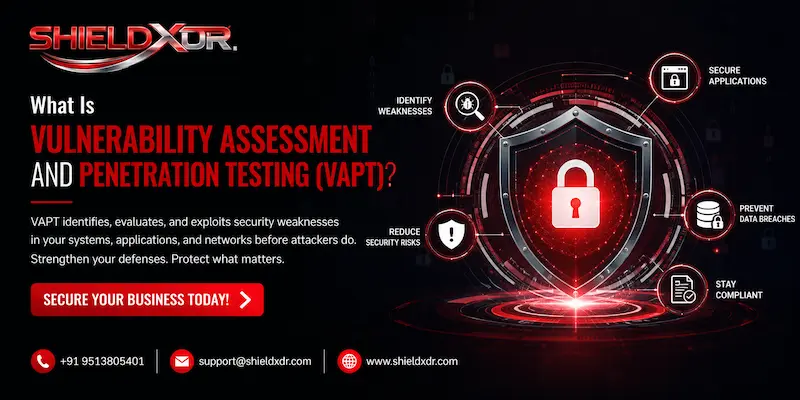
Do you know what VAPT is, and how it can help organizations running in the IT Industry offline and online? If not, then you are at the right place. Here, we will talk about what VAPT and its features are in detail.
Moreover, we will introduce you to a reliable security solution offered by a reputable VAPT service provider. What are we waiting for? Let’s get straight to the topic!
What Is Vulnerability Assessment and Penetration Testing?
Vulnerability Assessment and Penetration Testing (VAPT) is a thorough security testing approach that involves carefully scanning a network or application to find technical problems, then using controlled, simulated attacks to safely exploit those vulnerabilities.
While the assessment phase serves as a diagnostic scan to find and catalog known vulnerabilities, the penetration testing phase attempts to penetrate defenses in the same way that a real hacker would in order to show the real-world consequences of those weaknesses.
In the end, this dual strategy gives businesses a thorough road map of their security flaws and practical corrective actions to strengthen their infrastructure against online attacks. Let’s talk about what VAPT is and how you can get better security facilities with such services!
Vulnerability Assessment vs Penetration Testing: What’s the Difference?
|
S.No. |
Topics |
Factors |
What? |
|
1. |
Vulnerability Assessment |
Objective |
It is a comprehensive, automated scan intended to find, record, and catalog known security flaws in a system without actually taking advantage of them. |
|
Approach |
It focuses on high-coverage detection, listing potential entry points and security fixes that are missing, much like a regular health check. |
||
|
2. |
Penetration Testing |
Objective |
In this focused, manual security exercise, ethical hackers actively try to penetrate defenses by taking advantage of flaws that have been found. |
|
Approach |
It functions as a simulated attack to see precisely how far a hacker could penetrate the network and what data they could steal, with an emphasis on depth and practical impact. |
Who Needs VAPT Services?
The following industries and individuals need VAPT services:
● Banking, Financial Services, and Insurance (BFSI): Required to adhere to stringent international banking regulations, safeguard sensitive user accounts, and secure enormous cash flows.
● Healthcare and Medical Providers: Needed to stop the theft of extremely private patient medical records and stop ransom assaults on life-saving devices.
● E-Commerce and Retail Platforms: Needed to protect consumer credit card information, prevent significant data leaks, and defend digital payment gateways.
● Government Agencies and Public Infrastructure: Needed to prevent state-sponsored cyberwarfare, safeguard public documents, and defend vital national systems.
● SaaS Providers and Tech Startups: Have to obtain enterprise contracts, demonstrate data security to investors, and correct coding errors before product launches.
Benefits of Vulnerability Assessment and Penetration Testing
The following are some of the benefits of VAPT:
a) Proactive Risk Identification: It finds exploits and hidden system vulnerabilities before malevolent hackers can discover and take advantage of them.
b) Compliance and Regulatory Alignment: In order to avoid severe legal repercussions, it complies with mandatory international security standards such as PCI-DSS, ISO 27001, and SOC 2.
c) Prevention of Costly Data Breaches: By preventing attacks before they occur, it saves companies millions of dollars in recovery expenses, ransom demands, and legal fees.
d) Protection of Brand Reputation and Trust: By demonstrating the proactive security of your digital infrastructure, it preserves partner loyalty and customer confidence.
e) Actionable Remediation Insights: It provides your IT staff with a step-by-step, prioritized technical blueprint to address the most serious security vulnerabilities first.
Types of Vulnerability Assessment
|
S.No. |
Types |
What? |
|
1. |
Network-Based Assessments |
Finds unprotected network services, misconfigured firewalls, and exposed ports by scanning both wired and wireless networks. |
|
2. |
Host-Based Assessments |
Looks for unpatched operating systems, weak passwords, and configuration mistakes on specific servers, workstations, and endpoints. |
|
3. |
Wireless Network Assessments |
Detects rogue devices, weak encryption standards, and unauthorized access points by auditing Wi-Fi networks and access points. |
|
4. |
Application Assessments |
To find software defects, injection flaws, and cross-site scripting (XSS) vulnerabilities, analyze web apps and APIs. |
|
5. |
Database Assessments |
Searches database management systems for unpatched database software, SQL injection threats, and lax access controls. |
Common Vulnerabilities Identified During VAPT
The following are some common vulnerabilities identified during VAPT:
1. Broken Authentication and Session Management: Hackers can take control of user identities due to lax password protections and inadequately secured session tokens.
2. Injection Flaws (e.g., SQLi, XSS): Filterless input fields allow hackers to insert malicious code to take over users' browsers or alter databases.
3. Security Misconfigurations: Leftover default passwords, unprotected communication connections, and overly liberal system settings that present entry points.
4. Using Components with Known Vulnerabilities: Outdated plugins, libraries, and frameworks that include publicized code weaknesses ripe for exploitation.
5. Broken Access Control: Flawed permission logic that permits regular users to access administrative or privileged data.
VAPT Methodologies and Industry Standards
The following are some VAPT methodologies and industry standards:
● OWASP: The leading, internationally recognized standard for finding and fixing serious security vulnerabilities in web and mobile applications.
● NIST SP 800-115: An organized system that offers formal corporate and governmental rules for carrying out technical security evaluations.
● PTES: A thorough, step-by-step guide outlining the precise operating procedures for a professional penetration test.
● OSSTMM: A rigorous, metrics-driven approach aimed at monitoring operational security across networks and channels in a scientific manner.
● ISSAF: A highly technical architecture that connects particular target systems to the precise testing instruments and procedures needed to audit them.
Tools Commonly Used for Vulnerability Assessment and Penetration Testing
|
S.No. |
Tools |
What? |
|
1. |
Nmap (Network Mapper) |
An open-source network scanner that finds running operating systems, open ports, and active hosts on a network. |
|
2. |
Nessus |
Businesses utilize this all-inclusive, automated vulnerability assessment tool to check systems for security configurations and fixes. |
|
3. |
Burp Suite |
Traffic between a browser and the target server can be intercepted, examined, and exploited using this potent web application security testing tool. |
|
4. |
Metasploit Framework |
A popular penetration testing platform that offers payloads, infrastructure, and validated exploits to safely exploit vulnerabilities found. |
|
5. |
Wireshark |
A comprehensive network packet analyzer that records and examines real-time traffic to identify unusual network activity and unencrypted data transfers. |
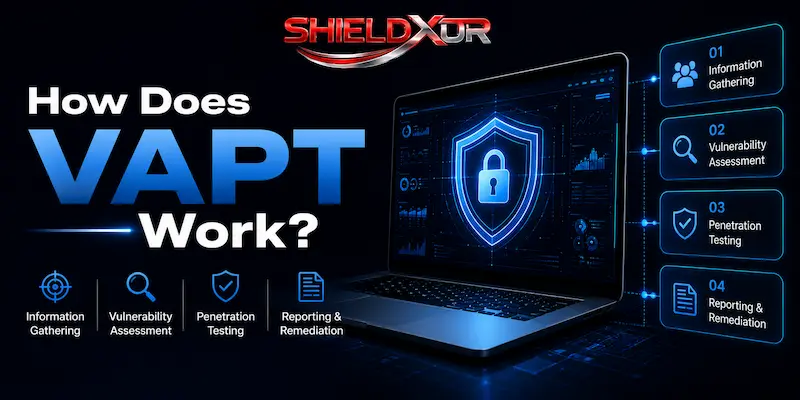
How Does VAPT Work? Step-by-Step Process
VAPT works in the following steps:
a) Planning and Scoping: Establishing the parameters of the test, the legal authorization, and the particular systems that will be assessed.
b) Information Gathering and Reconnaissance: Mapping out target infrastructure by gathering IP addresses, domain information, and public intelligence.
c) Vulnerability Detection (Scanning): Using automated methods to find unpatched software vulnerabilities, configuration mistakes, and open ports.
d) Information Analysis and Exploitation: Using a controlled environment to manually attack the vulnerabilities found to compromise the systems.
e) Reporting and Remediation: Recording every exploit discovered and providing the IT staff with priority, detailed instructions on how to resolve it.
What Happens After VAPT?
The following things happen after VAPT:
1. Detailed VAPT Report Delivery: Obtaining a ranked list of security vulnerabilities found, together with the technical procedures needed to address them.
2. Remediation and Patch Management: Assigning the task of repairing and sealing the found security flaws to your internal IT or development staff.
3. Re-Testing (Verification Scanning): Conducting a follow-up evaluation to verify that every security patch that has been implemented is operating as intended.
4. Attestation and Compliance Certification: Obtaining official security clearance papers to comply with regulatory requirements, investors, and auditors.
5. Continuous Monitoring and Governance: Making the switch to regular security scanning schedules can help you find new vulnerabilities when your software upgrades.
Challenges and Limitations of VAPT
|
S.No. |
Factors |
What? |
|
1. |
False Positives and Negatives |
Automated systems may inadvertently identify threats that don't exist or overlook intricate, deeply concealed security vulnerabilities. |
|
2. |
Point-in-Time Constraint |
As soon as a new patch or software update is released, the results are immediately out of date and only offer a snapshot of security. |
|
3. |
Risk of Operational Disruption |
During penetration testing, excessive exploitation efforts may inadvertently cause data corruption, system crashes, or service outages. |
|
4. |
Heavy Reliance on Human Expertise |
Only simple faults are detected by automated scans; the ability of the tester to find complex logic errors is entirely up to them. |
|
5. |
Scope-Defined Blind Spots |
While VAPT exercises are strictly restricted to pre-approved assets, leaving excluded systems untested, real hackers do not adhere to restrictions. |
How to Choose the Right VAPT Service Provider?
You can choose the right VAPT service provider in the following ways:
● Verify Certified Expertise: Make sure the members of their technical staff have reputable, practical cybersecurity certificates such as OSCP, CEH, or CISSP.
● Assess Industry-Specific Experience: Select a vendor who is well-versed in the regulatory compliance rules and the particular threat landscape of your industry.
● Evaluate Reporting Quality: Examine anonymized sample reports to make sure they provide precise, useful remediation advice rather than just automated tool readouts.
● Check for Hybrid Testing Methodologies: Choose a supplier who successfully blends extensive, human-led manual penetration testing with automated scaling.
● Review Post-Assessment Support: To make sure your modifications are truly effective, make sure the vendor offers thorough patch verification and retesting services.
Why Choose Craw Security for Professional VAPT Services?
Now that we have talked about what VAPT is, you might want to get a dedicated security solution to fight against unknown cyber threats with ease. For that, you can go for ShieldXDR, a dedicated threat detection and response tool offered by Craw Security.
ShieldXDR can use various features to automatically detect any suspicious activity over your systems and networks and can respond to it without any human intervention. Thus, you can feel at ease working online. What are you waiting for? Contact, Now!
Frequently Asked Questions
About VAPT
1. What is Vulnerability Assessment and Penetration Testing (VAPT)?
The methodical security testing procedure known as Vulnerability Assessment and Penetration Testing (VAPT) combines automated scanning to find technical vulnerabilities with simulated manual attacks to take advantage of those holes and safeguard the system.
2. What is the difference between Vulnerability Assessment and Penetration Testing?
While penetration testing is a manual, simulated attack that actively exploits security weaknesses to assess real-world risk, vulnerability assessment is an automated scan that generally finds known security problems.
3. Why is VAPT important for organizations?
VAPT important for organizations for the following reasons:
a) Identifies Vulnerabilities Before Attackers Do,
b) Prevents Devastating Financial Losses,
c) Ensures Regulatory Compliance,
d) Maintains Customer Trust and Reputation, and
e) Provides a Prioritized Patching Blueprint.
4. How often should a business perform a VAPT assessment?
A VAPT assessment should be carried out by a company at least once or twice a year, as well as right away after any substantial software updates, network modifications, or system infrastructure overhauls.
5. What types of systems can be tested through VAPT?
The following types of systems can be tested through VAPT:
a) Web Applications and APIs,
b) Network Infrastructure,
c) Cloud Environments,
d) Mobile Applications, and
e) IoT and Embedded Devices.
6. Which tools are commonly used for Vulnerability Assessment and Penetration Testing?
The following tools are commonly used for VAPT:
a) Nmap,
b) Nessus,
c) Burp Suite,
d) Metasploit Framework, and
e) Wireshark.
7. How long does a typical VAPT assessment take?
Depending on the size, complexity, and extent of the organization's digital infrastructure, a typical VAPT assessment can be finished in one to four weeks.
8. Does VAPT guarantee complete protection against cyberattacks?
Because VAPT is a point-in-time assessment that cannot anticipate future zero-day exploits, human mistakes, or new vulnerabilities brought about by daily system modifications, it cannot offer total protection.
9. Which industries are required to conduct VAPT for compliance?
The following industries are required to conduct VAPT for compliance:
a) Banking and Financial Services (BFSI),
b) Healthcare and Pharmaceuticals,
c) E-commerce and Retail,
d) Government and Defense Contractors, and
e) Technology and SaaS Providers.
10. How do I choose the right VAPT service provider for my business?
You can choose the right VAPT service provider for my business in the following ways:
a) Verify Certified Expertise,
b) Assess Industry-Specific Experience,
c) Evaluate the Quality of Sample Reports,
d) Check for Hybrid Testing Methodologies, and
e) Review Post-Assessment Support and Re-Testing.
Daksh
Cybersecurity expert and contributor at ShieldXDR, dedicated to sharing insights on threat detection, response, and overall digital security posture.