What Is Lateral Movement and How Does XDR Detect It?
Do you know what Lateral Movement is and how organizations can use such techniques to protect themselves from cyber attacks? If not, then you are at the right place. Here, we will talk about Lateral Movement and related features in detail.
Moreover, we will introduce you to a reliable XDR solution offered by a reputable VAPT service provider. What are we waiting for? Let’s get started!
What Is Lateral Movement in Cybersecurity?
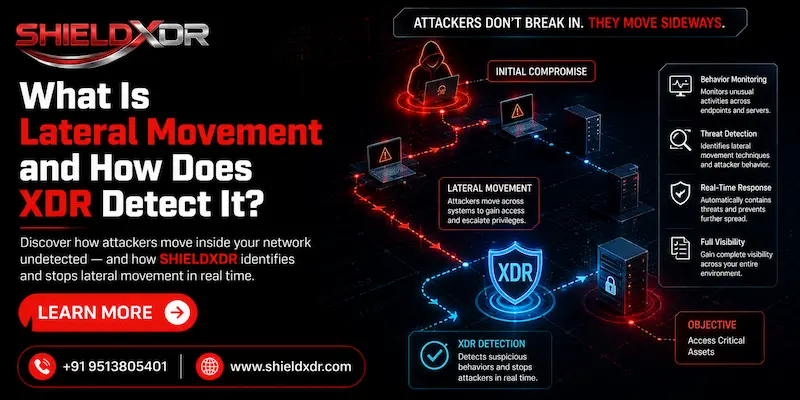
After achieving initial access, lateral movement in cybersecurity refers to the method used by opponents to delve further into a network in pursuit of sensitive data, high-value assets, or elevated credentials.
Attackers can enlarge their footprint and achieve long-term persistence in the environment by compromising additional systems and user accounts. The ability to move away from the initial entry point is a vital stage in the attack lifecycle, enabling threats to propagate quietly throughout an enterprise's infrastructure.
Let’s take a look at what Lateral Movement is, its uses, its features, and its benefits for organizations!
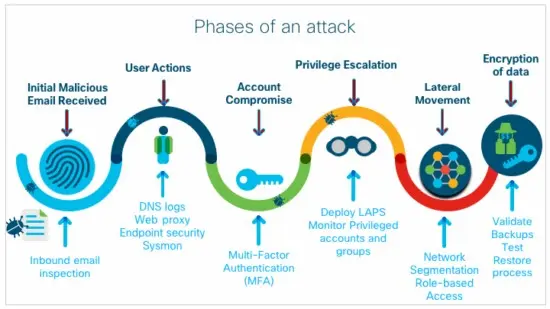
Stages of a Lateral Movement Attack: Step-by-Step Breakdown
|
S.No. |
Stages |
What? |
|
1. |
Reconnaissance and Internal Mapping |
The assailant charts the layout of the internal network, identifies active ports, and locates weak points in cloud resources. |
|
2. |
Credential Harvesting |
They elevate access privileges by stealing local passwords, memory tokens, or API keys. |
|
3. |
Authentication and Exploitation |
The malicious actor accesses nearby systems of high value using the pilfered, valid credentials. |
|
4. |
Persistence and Foothold Expansion |
They create permanent backdoors on various compromised assets to guarantee ongoing access to the network. |
|
5. |
Target Acquisition and Execution |
The assailant identifies the final target resources to extract data from or to use ransomware on. |
Common Lateral Movement Techniques Used by Cybercriminals
The following are some common lateral movement techniques used by cybercriminals:
1. Credential Dumping and Pass-the-Hash: Taking authentication hashes kept in memory to log in to remote servers without requiring the password in plain text.
2. Living off the Land (LotL): Using reliable administrative tools that are already installed, such as PowerShell or WMI, to carry out harmful commands in a hidden manner.
3. Remote Desktop Protocol (RDP) Abuse: Utilizing compromised valid credentials to gain direct access to neighboring systems through conventional graphical remote access.
4. Exploitation of Internal Vulnerabilities: Scanning for and taking advantage of unaddressed vulnerabilities or configuration errors in the internal network to move between systems.
5. SSH Key and Session Hijacking: Illegally obtaining private SSH keys or taking control of trusted terminal sessions in progress to navigate through Linux and cloud environments at will.
How Attackers Use Lateral Movement to Reach Critical Systems?
Attackers use lateral movement to reach critical systems in the following ways:
● Exploiting Trust Relationships: They switch between interlinked systems that have an inherent trust in each other's messages.
● Abusing Administrative Tools: They employ valid built-in tools to run commands on remote servers without verification.
● Leveraging Elevated Credentials: They exploit stolen high-privilege keys to gain unrestricted access to critical environments.
● Targeting Network Misconfigurations: They traverse unsegmented network pathways to reach isolated areas of high value.
● Hijacking Active Sessions: They hijack open, authenticated user connections to circumvent login security measures.
Why is Lateral Movement One of the Biggest Security Risks for Organizations?
|
S.No. |
Factora |
Why? |
|
1. |
Turns a Small Breach into a Major Crisis |
A single compromised endpoint can rapidly escalate into a complete corporate network breach. |
|
2. |
Enables Data Exfiltration and Ransomware Spreading |
It offers the necessary access to pilfer proprietary data and implement ransomware across the entire enterprise. |
|
3. |
Allows Attackers to Maintain Long-Term Persistence |
Attackers conceal themselves through various backdoors, guaranteeing their continued entrenchment even if they are found on one machine. |
|
4. |
Bypasses Static Perimeter Defenses |
It operates solely within the trusted network zone, thus avoiding conventional firewalls altogether. |
|
5. |
Exploits Internal Operational Blind Spots |
It flourishes due to the absence of internal network surveillance, allowing opponents to operate unnoticed for extended periods. |
Real-World Examples of Lateral Movement in Cyber Attacks
The following are real-world examples of lateral movement in cyber attacks:
a) The Target Data Breach (2013): Using a third-party HVAC vendor as an entry point, attackers accessed the system and moved laterally to the internal point-of-sale systems.
b) The NotPetya Ransomware Campaign (2017): The malware employed automated Mimikatz credential theft and EternalBlue exploits to quickly navigate through corporate networks.
c) The SolarWinds Supply Chain Attack (2020): Malicious actors exploited a compromised software update to gain access, subsequently moving to cloud environments with the aid of stolen SAML tokens.
Challenges of Detecting Lateral Movement with Traditional Security Tools
The following are the challenges of detecting lateral movement with traditional security tools:
1. Perimeter-Centric Blindness: Tools for security that are legacy concentrate on external boundaries to a great extent, which results in their inability to detect traffic that moves east-west within the network.
2. Abuse of Legitimate Credentials: Lateral movement goes unflagged by traditional systems, as the attacker gains access through valid, stolen user accounts.
3. "Living off the Land" Mimicry: By using trusted, built-in administrative tools, malicious activity can easily blend in with daily operations.
4. Lack of Contextual Telemetry: Standard security alerts do not provide the necessary correlation to connect isolated incidents into a visible, continuous attack path.
5. Ephemeral and Dynamic Cloud Assets: Traditional monitoring tools' signature updates are static and cannot keep up with short-lived workloads and constant API changes.
What Is XDR (Extended Detection and Response)?
Extended Detection and Response (XDR) serves as a consolidated platform for detecting and responding to security incidents. It automatically gathers, correlates, and analyzes telemetry data across various security layers, such as endpoints, networks, cloud workloads, and identities.
XDR offers security teams comprehensive visibility and automated context to identify sophisticated threats and coordinate swift, unified actions from a single interface, by dismantling conventional security silos.
How Does XDR Detect Lateral Movement Across the Enterprise?
XDR detects lateral movement across the enterprise in the following ways:
● Correlates Multi-Domain Telemetry: It combines isolated alerts from endpoints, networks, and cloud workloads into a unified and coherent attack timeline.
● Analyzes Behavioral Baselines (UBA): It highlights slight changes in typical user behavior, revealing harmful actions concealed behind pilfered valid credentials.
● Identifies "Living off the Land" Tactics: It identifies the harmful reuse of reliable, integrated administrative tools such as PowerShell or WMI.
● Tracks East-West Network Anomalies: It observes internal traffic trends to identify atypical data transfers and unapproved links between segmented areas.
● Traces Identity Pivots Across Environments: It tracks the path of an attacker as they alternate between different machine accounts and cloud identity permissions.
How do AI and Behavioral Analytics Improve Lateral Movement Detection?
AI and behavioral analytics improve lateral movement detection in the following ways:
a) Establishes Baseline User and Entity Behavior (UEBA): It learns the normal daily operational routines so that it can instantly flag anomalous logins or sudden privilege escalations.
b) Identifies "Living off the Land" Anomalies: It detects when reliable administrative tools are employed at atypical times or with command arguments that deviate significantly from the norm.
c) Correlates Fragmented Events into Graphs: It connects isolated, low-severity incidents from various systems into one unified visual representation of an attack path.
d) Detects Unprecedented Traffic Shifts: It automatically identifies micro-segments of internal network activity that differ from historical communication patterns.
e) Adapts Dynamically to Cloud Environments: It adapts detection rules to the fast-evolving cloud assets on an ongoing basis, without dependence on static signatures.
How does Threat Hunting complement XDR for Lateral Movement Detection?
|
S.No. |
Factora |
How? |
|
1. |
Uncovers Blind Spots Missed by Automated Rules |
Hunters conduct manual searches for novel or customized attack techniques that can circumvent standard security algorithms. |
|
2. |
Validates and Contextualizes High-Fidelity Alerts |
They provide human context for intricate XDR data to validate actual threats and remove concealed false positives. |
|
3. |
Creates New Detection Signatures for the XDR Platform |
Findings from hunts are transformed into automated rules to strengthen the platform's future defenses. |
|
4. |
Investigate Sophisticated "Slow and Low" Attacks |
They assemble together subtle, malicious actions that occurred at different times and did not set off automated real-time thresholds. |
|
5. |
Assesses Vulnerable Trust Relationships Interactively |
To prevent attackers from exploiting them, hunters actively investigate internal configurations to locate and secure weak communication routes. |
The Role of Zero Trust Architecture in Preventing Lateral Movement
The following are the roles of zero trust architecture in preventing lateral movement:
1. Enforces Least Privilege Access: User and device permissions are limited to the bare minimum necessary, preventing access to adjacent systems through unauthorized means.
2. Implements Micro-Segmentation: It segments the internal network into isolated, secure zones, stopping threats from spreading freely across environments.
3. Mandates Continuous Authentication: During active sessions, it continuously assesses identity and device posture, severing the connections of attackers who take control of open links.
4. Requires Explicit Verification: It defaults to treating all access requests as untrusted, necessitating rigorous context validation irrespective of the user's location.
5. Minimizes Attack Surface: It hides essential infrastructure and internal resources from those without permission to access them, providing attackers with no options for redirection.
Conclusion: Why XDR Is Essential for Detecting and Stopping Lateral Movement?
Now that we have talked about what Lateral Movement is, you might want to get your hands on a dedicated XDR solution from a reliable source. For that, you can go for ShieldXDR, a dedicated threat detection and response tool offered by Craw Security.
ShieldXDR can help organizations protect themselves against unknown threats and suspicious activities on their systems. Thus, you can feel safer while working online. What are you waiting for? Contact, Now!
Frequently Asked Questions
About Lateral Movement
1. What Is Lateral Movement in Cybersecurity?
After cybercriminals gain initial access, they use the technique of lateral movement to navigate through an internal network in search of sensitive data and high-value assets.
2. How Does Lateral Movement Work in a Cyber Attack?
Lateral movement works in a cyber attack in the following ways:
a) Internal Reconnaissance,
b) Credential Harvesting,
c) Exploitation & Pass-the-Hash,
d) Remote Execution & Access, and
e) Persistence & Escalation.
3. Why Is Lateral Movement Dangerous for Organizations?
Lateral movement is dangerous for organizations for the following reasons:
a) Harder to Detect (Blends In with Normal Activity),
b) Expands the Scope of Damage,
c) Enables Privilege Escalation,
d) Increases Attacker Dwell Time & Persistence, and
e) Sets Up High-Impact Attacks (e.g., Ransomware).
4. How Does XDR Detect Lateral Movement Across a Network?
XDR detects lateral movement across a network in the following ways:
a) Cross-Layer Data Correlation,
b) User and Entity Behavior Analytics (UEBA),
c) Detection of "Living off the Land" (LotL) Tactics,
d) Network Traffic and Protocol Inspection, and
e) Automated Attack Graphs and Timeline Visualizations.
5. What Are the Most Common Lateral Movement Techniques Used by Attackers?
The following are the most common lateral movement techniques used by attackers:
a) Pass-the-Hash (PtH) and Pass-the-Ticket (PtT),
b) Exploiting Remote Services (RDP, SMB, & PsExec),
c) Windows Management Instrumentation (WMI) & WinRM / PowerShell,
d) Abuse of Centralized IT & Deployment Tools, and
e) Internal Vulnerability Exploitation.
6. Can XDR Prevent Lateral Movement Before a Data Breach Occurs?
Yes, XDR can stop lateral movement before a data breach happens by automatically identifying unusual internal activities and isolating affected endpoints or revoking stolen credentials in real time.
7. What Is the Difference Between XDR and EDR for Detecting Lateral Movement?
EDR focuses solely on monitoring endpoint processes and file activity, whereas XDR correlates endpoint data with network traffic and identity logs to uncover host-to-host movement throughout the entire network.
8. How Does AI Improve XDR's Ability to Detect Lateral Movement?
AI improves XDR’s ability to detect lateral movement in the following ways:
a) Dynamic Behavioral Baselining,
b) Contextual "Living off the Land" (LotL) Analysis,
c) Automated Signal Correlation Across Silos,
d) Predictive Attack Path Mapping, and
e) Faster Automated Triage & Containment.
9. What Are the Warning Signs of Lateral Movement in a Network?
The following are the warning signs of lateral movement in a network:
a) Unusual Administrative Tool Usage,
b) Spikes in Internal "East-West" Traffic & Port Scanning,
c) Abnormal Logon Events & Credential Anomalies,
d) Excessive LSASS Memory Access, and
e) Creation of Unfamiliar Scheduled Tasks or Services.
10. What Best Practices Help Prevent Lateral Movement in Enterprise Environments?
The following are the best practices to help prevent lateral movement in enterprise environments:
a) Implement Zero Trust Architecture & Microsegmentation,
b) Enforce the Principle of Least Privilege & MFA,
c) Secure Administrative Credentials & Tiered Access,
d) Hardening Endpoints & Disabling Unused Protocols, and
e) Continuous Monitoring with XDR & Behavioral Analytics.
Daksh
Cybersecurity expert and contributor at ShieldXDR, dedicated to sharing insights on threat detection, response, and overall digital security posture.